
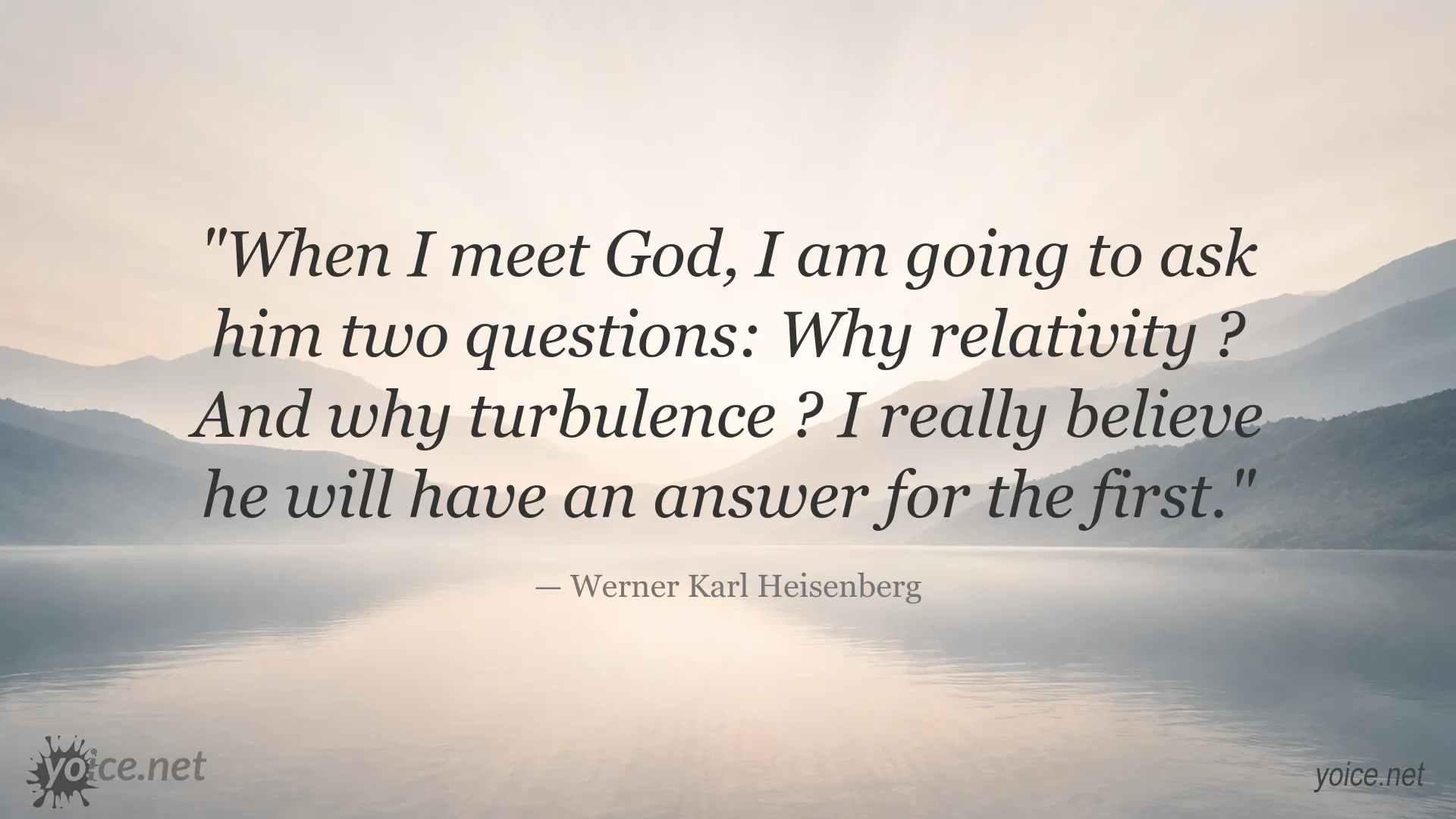
„When I meet God, I am going to ask him two questions: Why relativity ? And why turbulence ? I really believe he will have an answer for the first.“
Werner HeisenbergQuote by Werner Heisenberg on questions of relativity and turbulence in physics with a philosophical context.
Werner Heisenberg was a German physicist and Nobel laureate, known as one of the founders of quantum mechanics.
This quote by Werner Heisenberg addresses fundamental questions of physics from a philosophical perspective.
Translation or original: 🇩🇪Click here
Quelle: Hier klicken
i
3.0
/ 5
👥 Community:
Share this entry
Werner Heisenberg (1901–1976) was a prominent German physicist considered one of the pioneers of quantum mechanics. He was awarded the Nobel Prize in Physics in 1932 for his work. Heisenberg made significant contributions to understanding atomic structure and the physical foundations of quantum mechanics.
 Copyright © yoice.net – Quote Artwork
"Gentlemen, as a physicist who has dedicated his entire life to the sober pursuit of science, to the exploration of matter, I am certainly free from the suspicion of being taken for an idle dreamer.
And so, after my investigations into the atom, I declare this: There is no such thing as matter in itself.
All matter comes into being and persists only through a force—a force that sets the particles of the atom into vibration and binds them together as the minutest solar system of the cosmos. Yet, since neither an intelligent nor an eternal force exists within the vast expanse of the universe—for humanity has failed to devise the long-sought perpetuum mobile—we must posit behind this force a conscious, intelligent spirit. This spirit is the primal source of all matter. It is not the visible, transient matter that constitutes the real, the true, the actual—for without the spirit, matter would not exist at all—but rather the invisible, immortal spirit that is the ultimate truth! Yet, since spirit alone cannot exist either, and every spirit belongs to a being, we are compelled to assume the existence of spiritual beings. And since these beings cannot arise from themselves but must be created, I do not shy away from naming this mysterious creator as all civilized peoples of the earth have called Him in earlier millennia: God! Thus, the physicist, tasked with the study of matter, steps from the realm of the material into the realm of the spirit. And with that, our work concludes, and we must entrust our inquiry to the hands of philosophy."
Max Planck
 Copyright © yoice.net – Quote Artwork
"For what I want to say here, knowledge of the book's content is not necessarily required, because it concerns easily understandable facts about the cause and nature of gravitation—the force that presses everything to the ground and is not easily harnessed permanently for propulsion purposes, the force that keeps all celestial bodies in their orbits and holds our entire universe together. How gravitation achieves the feat of creating the conditions for our earthly life remains unexplained by science to this day. Science only offers a series of competing model concepts here. Even the nature of gravitation is largely unknown to it. As Sir Isaac Newton (1643–1727) said at the time: "I have explained the celestial phenomena and the tides based on gravity, but I have not been able to derive the cause of the properties of gravity from the phenomena so far." Nothing has changed since then. One who must know because he struggled daily with the problem of overcoming it, the former deputy chief engineer of the Rolls-Royce aircraft engine works, A. V. Cleaver, summed it up as follows, I quote literally: "Gravity is truly a highly mysterious and elusive phenomenon. It seems questionable whether many people, even technically trained ones, realize how justified this claim is or whether they notice the conspiracy of silence with which gravity is treated in most physics textbooks. It is almost reminiscent of a Polynesian taboo or the Victorian attitude towards certain topics such as sex or particular organs and functions, which were deemed somewhat improper. The student learns that all bodies attract each other, that the stability of the universe is determined thereby, and the equations of Newton's laws describe their effects. Yet—unless he is a specialized graduate student of pure physics—he is still expected to accept the old idea of “action at a distance,” and it is quite unlikely that any of his teachers will draw his attention to our complete ignorance of the physical relationships between gravity and other phenomena, simply because we know nothing about it and because the academic world apparently prefers not to broadcast this fact!""
Otto Jung
 Copyright © yoice.net – Quote Artwork
"Tormented by conflicting feelings, I appealed to reason ; and it is reason which, amid so many dogmatic contradictions, now forces the hypothesis upon me. A priori dogmatism, applying itself to God, has proved fruitless: who knows whither the hypothesis, in its turn, will lead us? I will explain therefore how, studying in the silence of my heart, and far from every human consideration, the mystery of social revolutions, God, the great unknown, has become for me an hypothesis, I mean a necessary dialectical tool."
Pierre-Joseph Proudhon
 Copyright © yoice.net – Quote Artwork
"Some people try to tell me that science will never answer the big questions we have in life. To them I say: baloney! The real problem is your questions aren't big enough."
Philip Plait
 Copyright © yoice.net – Quote Artwork
"The first gulp from the glass of natural sciences will make you an atheist, but at the bottom of the glass God is waiting for you."
Werner Heisenberg
 Copyright © yoice.net – Quote Artwork
"But in the end, science does not provide the answers most of us require. Its story of our origins and of our end is, to say the least, unsatisfactory. To the question, "How did it all begin?", science answers, "Probably by an accident." To the question, "How will it all end?", science answers, "Probably by an accident." And to many people, the accidental life is not worth living. Moreover, the science-god has no answer to the question, "Why are we here?" and, to the question, "What moral instructions do you give us?", the science-god maintains silence."
Neil Postman
 Copyright © yoice.net – Quote Artwork
 Copyright © yoice.net – Quote Artwork
Leave a Reply
Want to join the discussion?Feel free to contribute!