• Link to Youtube Link to Youtube Link to Youtube
  • Link to Telegram Link to Telegram Link to Telegram
  • Link to X Link to X Link to X
yoice.net
  • Quotes | yoice.net
    • Authors
      • Albert Einstein
      • Aldous Huxley
      • Ayn Rand
      • Edward Bernays | Father of modern propaganda
      • Friedrich Nietzsche | Quotes Collection
      • George Orwell | Quotes Collection
      • Hannah Arendt | Quotes, philosophies and timeless wisdom
      • Henry Louis Mencken | Astute critic and satirist
      • Joost A.M. Meerloo
      • Julian Huxley
      • Noam Chomsky
      • Sergei Kapiza
      • Walter Lippmann
    • Tags
      • Anarchy | Wisdom and the Philosophy of Freedom
      • Education
      • COVID1984 Quotes | Revealing the Madness
      • Democracy | Some revealing quotes
      • Money creation | Quotes about the magic of money
      • Jesuit
      • Mass media
      • Truth
      • Science
  • Earth Curve Calculator
  • Saved Quotes & Inspirations
  • Menu Menu

Information Scarcity in the 19th Century – Neil Postman

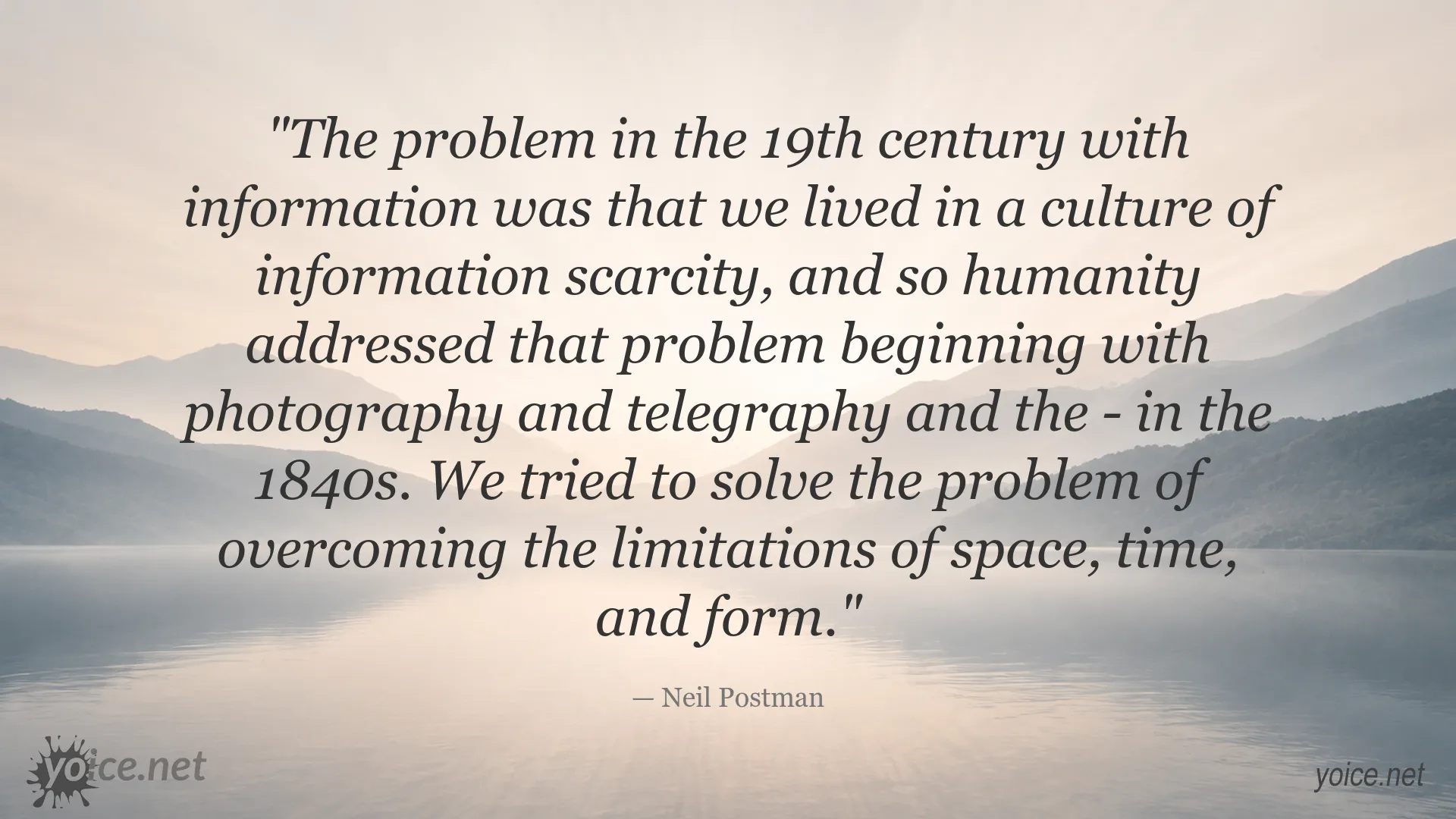
„The problem in the 19th century with information was that we lived in a culture of information scarcity, and so humanity addressed that problem beginning with photography and telegraphy and the - in the 1840s. We tried to solve the problem of overcoming the limitations of space, time, and form.“

Neil PostmanNeil Postman explains the 19th century information scarcity and how technologies like photography and telegraphy helped overcome space and time.
Previous Previous Previous Next Next Next

Neil Postman was an American media theorist, author, and educator known for his critiques of mass media, especially television, and its effects on society.

Neil Postman describes the challenges of information scarcity in the 19th century and the initial technological solutions.


Translation or original: 🇩🇪Click here

Quelle: Hier klicken

i

3.0 / 5
👥 Community:
*Advertisement | Affiliate links | Amazon affiliate
Literature on mass media
  • Propaganda | Edward L. Bernays
  • Propaganda: With an Introduction by Mark Crispin Miller
  • Propaganda: The Formation of Men's Attitudes
  • How Propaganda Works
  • Propaganda (Deluxe Edition): Includes Bonus Book: Crystallizing Public Opinion
Neil Postman | mediadigitizationinformationinformaticsproblemtechnologytechnicalcommunicationhistoryjournalismmass mediasolutions
Share this entry
  • Facebook Facebook Share on Facebook
  • Whatsapp Whatsapp Share on WhatsApp
  • Paper-plane Paper-plane Share on Telegram
  • Mail Mail Share by Mail

Quote image featuring Neil Postman on information scarcity in the 19th century

Neil Postman (1931–2003) was an American media theorist, cultural critic, and author. He taught communication at New York University and is best known for his books on media criticism such as "Amusing Ourselves to Death," in which he analyzes the impact of television on public communication and education.
Quote about transformation of social connections by Mattias DesmetCopyright © yoice.net – Quote Artwork
25. July 2024
/
0 Comments
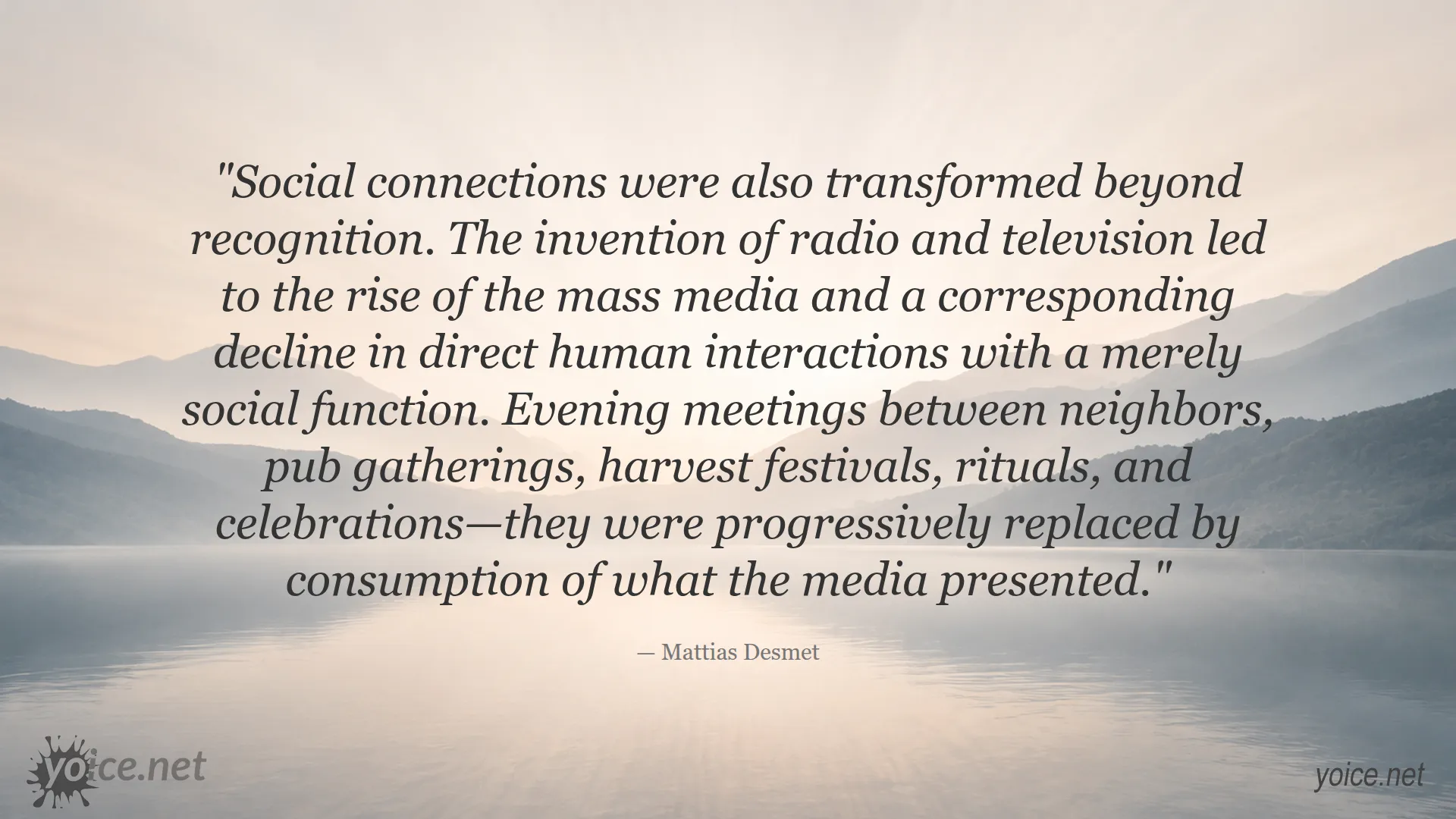
"Social connections were also transformed beyond recognition. The invention of radio and television led to the rise of the mass media and a corresponding decline in direct human interactions with a merely social function. Evening meetings between neighbors, pub gatherings, harvest festivals, rituals, and celebrations—they were progressively replaced by consumption of what the media presented." Mattias Desmet
Read more
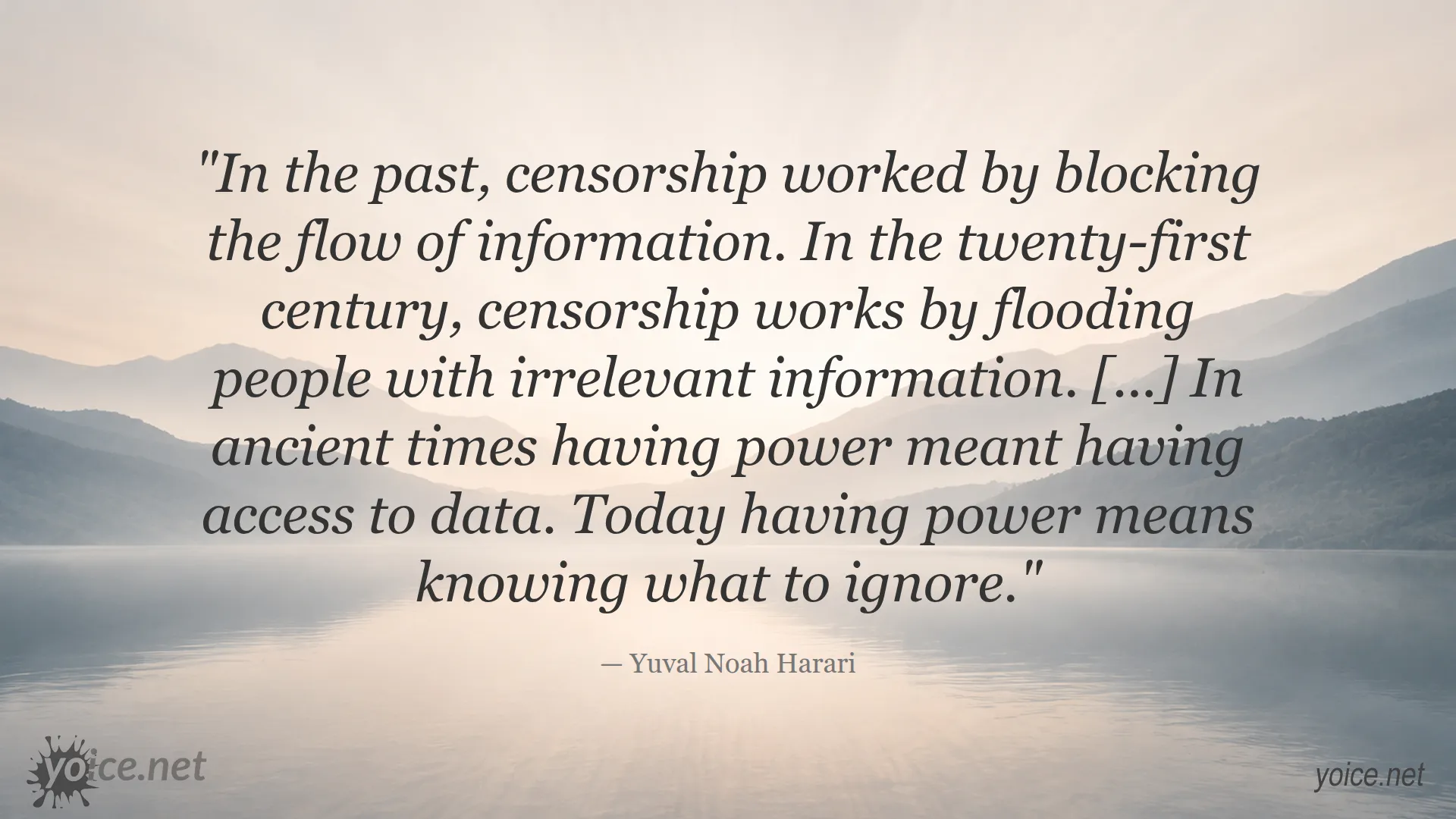
Quote by Yuval Noah Harari about how censorship works in the digital ageCopyright © yoice.net – Quote Artwork
20. April 2022
/
0 Comments
"In the past, censorship worked by blocking the flow of information. In the twenty-first century, censorship works by flooding people with irrelevant information. [...] In ancient times having power meant having access to data. Today having power means knowing what to ignore." Yuval Noah Harari
Read more
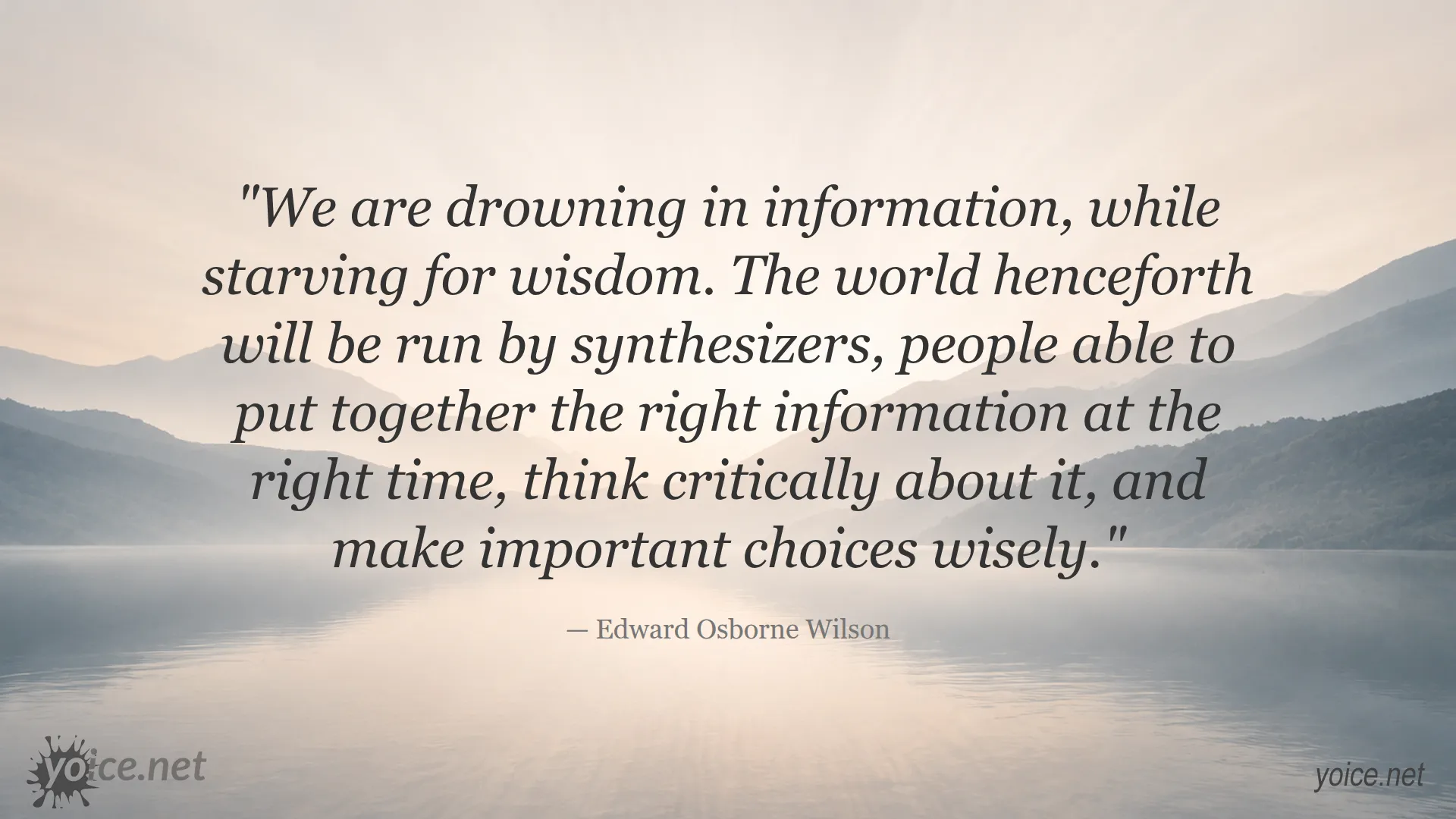
Quote by Edward Osborne Wilson about wisdom and synthesizing informationCopyright © yoice.net – Quote Artwork
17. July 2022
/
0 Comments
"We are drowning in information, while starving for wisdom. The world henceforth will be run by synthesizers, people able to put together the right information at the right time, think critically about it, and make important choices wisely." Edward Osborne Wilson
Read more
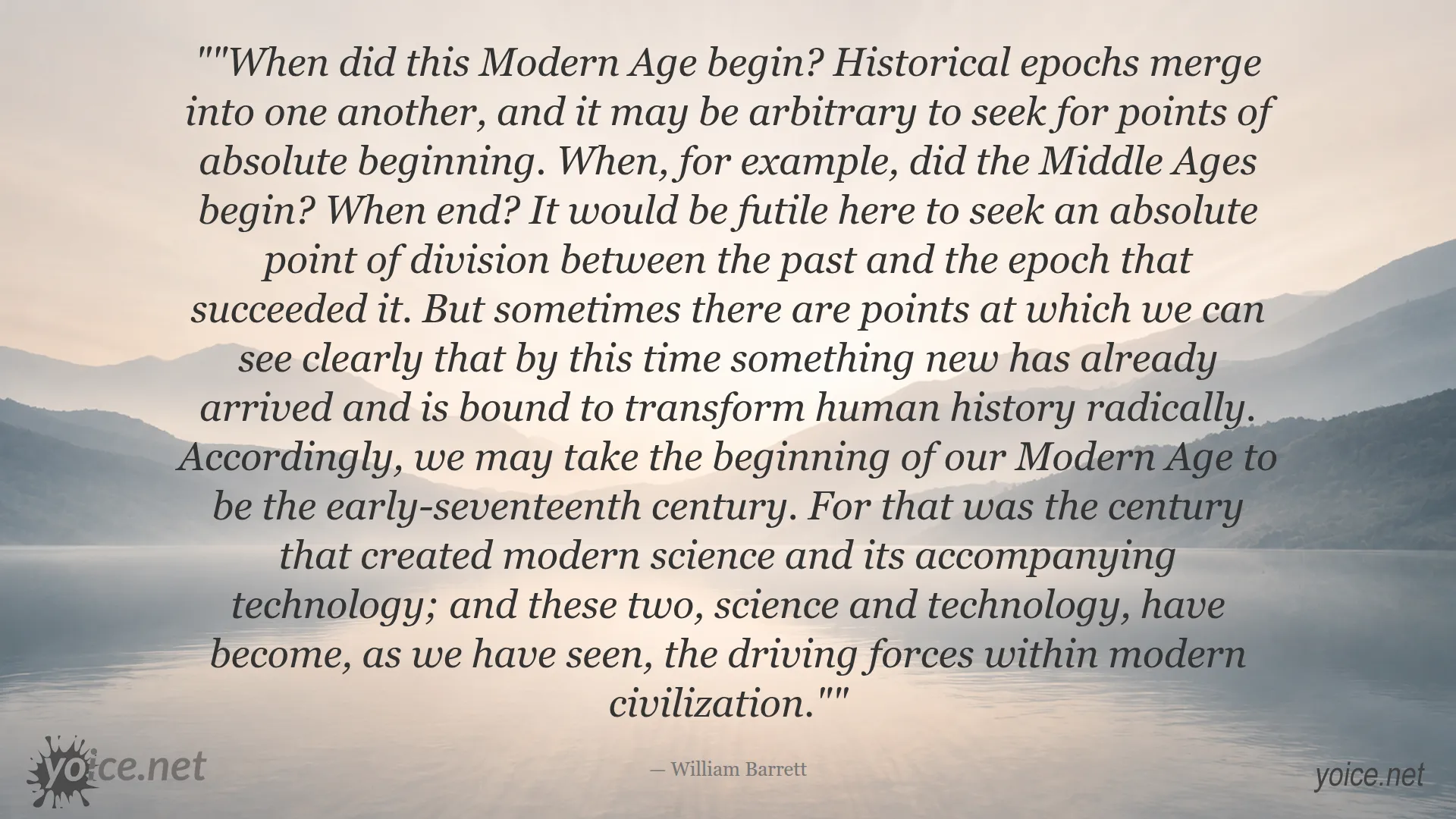
Quote by William Barrett about the beginning of the Modern Age and the rise of modern science and technologyCopyright © yoice.net – Quote Artwork
22. December 2022
/
0 Comments
""When did this Modern Age begin? Historical epochs merge into one another, and it may be arbitrary to seek for points of absolute beginning. When, for example, did the Middle Ages begin? When end? It would be futile here to seek an absolute point of division between the past and the epoch that succeeded it. But sometimes there are points at which we can see clearly that by this time something new has already arrived and is bound to transform human history radically. Accordingly, we may take the beginning of our Modern Age to be the early-seventeenth century. For that was the century that created modern science and its accompanying technology; and these two, science and technology, have become, as we have seen, the driving forces within modern civilization."" William Barrett
Read more
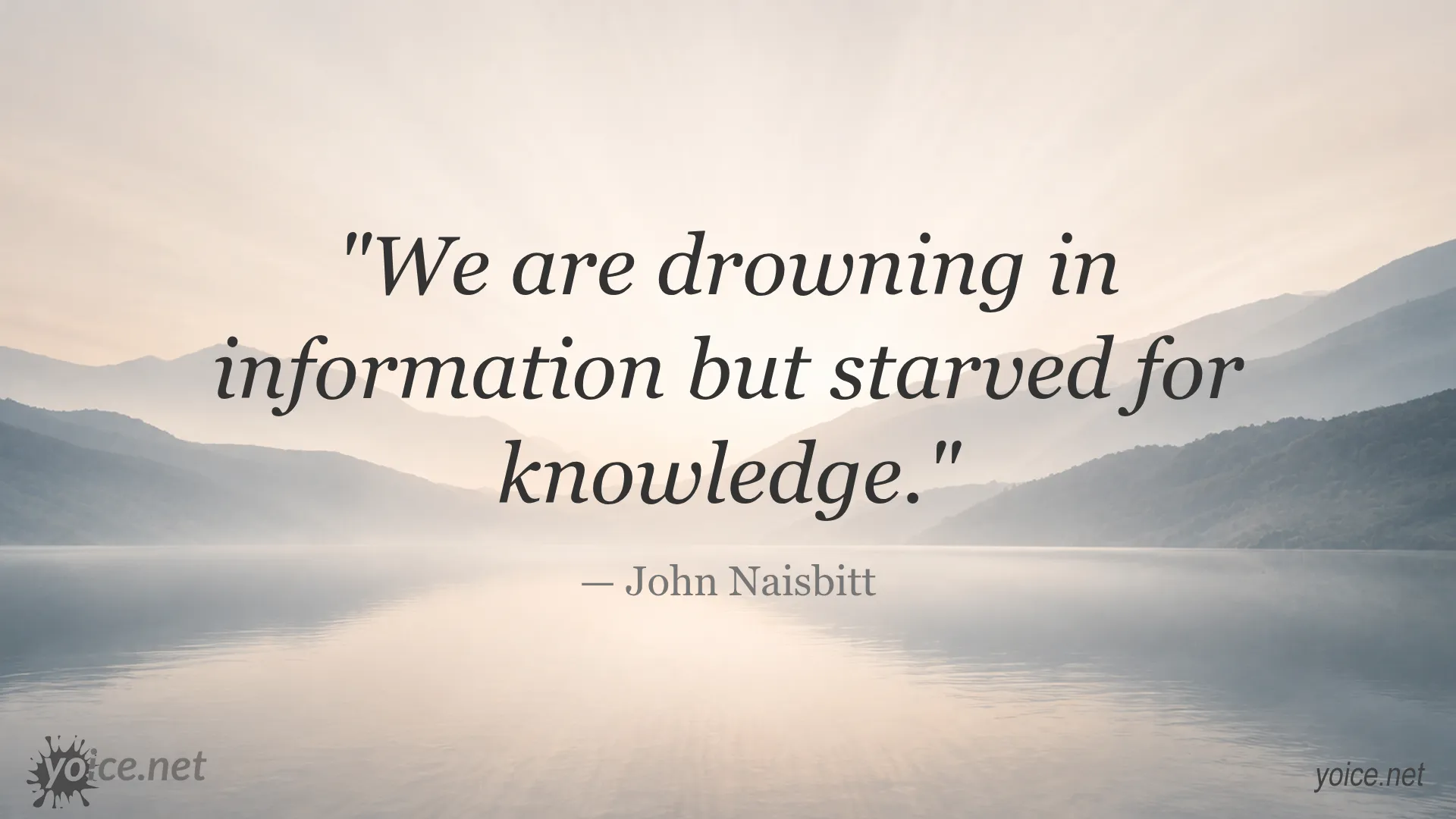
Quote by John Naisbitt about being overwhelmed by information yet starved for knowledgeCopyright © yoice.net – Quote Artwork
28. April 2026
/
0 Comments
"We are drowning in information but starved for knowledge." John Naisbitt
Read more
Quote by Jean Baudrillard about the world having more information and less meaningCopyright © yoice.net – Quote Artwork
21. January 2026
/
0 Comments
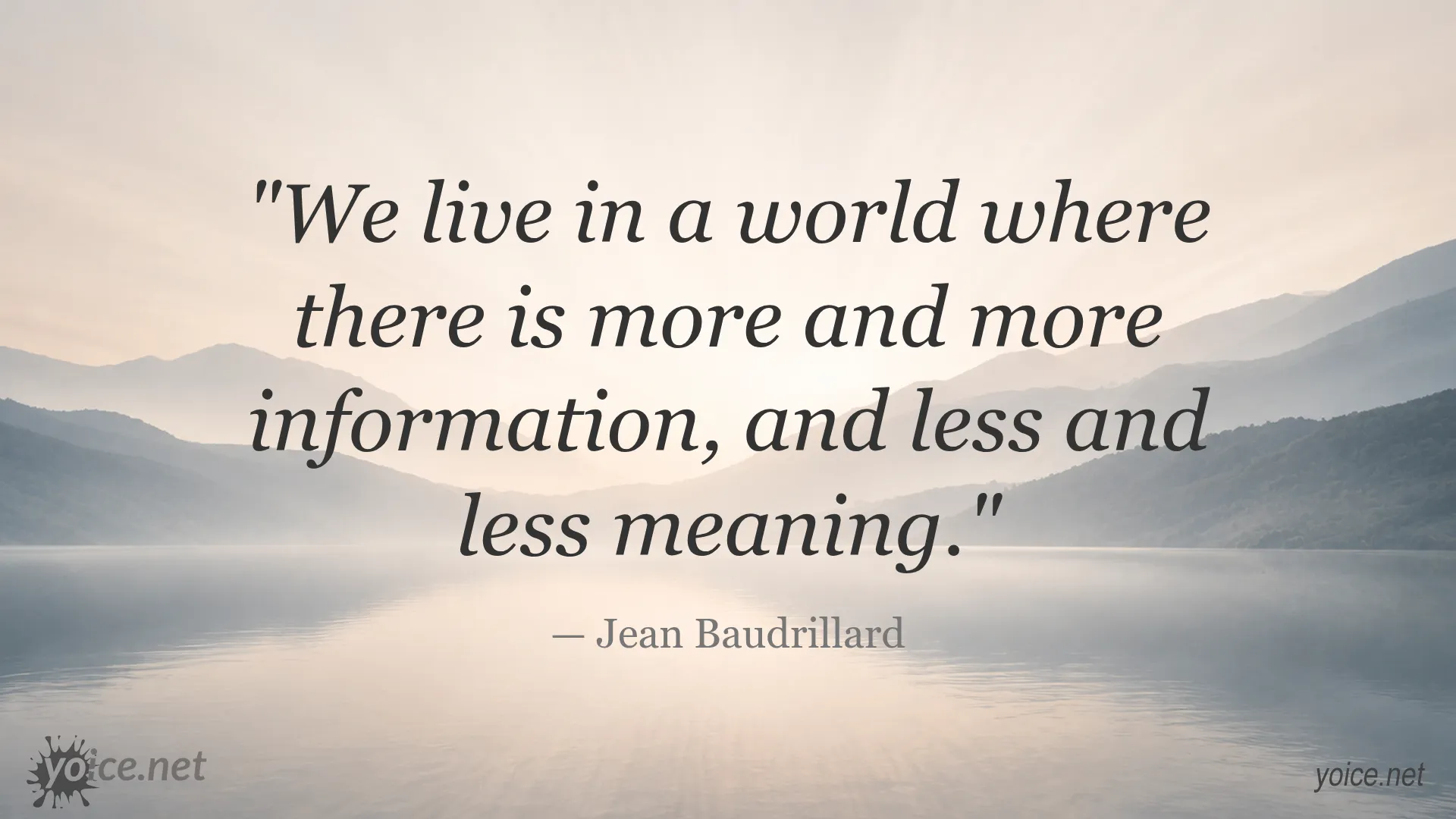
"We live in a world where there is more and more information, and less and less meaning." Jean Baudrillard
Read more
0 replies

Leave a Reply

Want to join the discussion?
Feel free to contribute!

Leave a Reply Cancel reply

Du musst angemeldet sein, um einen Kommentar abzugeben.

QR Code
Hans-Georg Gadamer Terence McKenna Albert Camus Mahatma Gandhi Albert Schweitzer Chris Hedges Albert Einstein George Bernard Shaw Mark Twain Pierre-Joseph Proudhon Antoine de Saint-Exupéry Eduardo Galeano Robert A. Heinlein Edward Bernays Charles Wright Mills John Taylor Gatto Voltaire Neil Postman Ludwig von Mises Thomas Sowell Aldous Huxley Leo Tolstoi Harry Edson Browne Murray Rothbard Walter Lippmann Friedrich Nietzsche George Orwell Ayn Rand Noam Chomsky Henry Ford H. L. Mencken Erich Fromm Marie von Ebner-Eschenbach Ivan Illich Umberto Eco Dr. Alan Bloom Elon Musk Clive Staples Lewis Gore Vidal Sokrates Milton Friedman Samuel Adams Heinrich Böll Thomas Kuhn Jonathan Swift John Trudell Emma Goldman Epiktet Nikola Tesla Oscar Wilde
©yoice.net • Realisierung: jan@pixel-park.net • Hosting - yoice.net Media • moyo-film.de | *As an Amazon Associate I earn from qualifying purchases.
  • Link to Youtube Link to Youtube Link to Youtube
  • Link to Telegram Link to Telegram Link to Telegram
  • Link to X Link to X Link to X
  • Contact
  • Cookie Policy (EU)
  • Privacy Policy
  • imprint
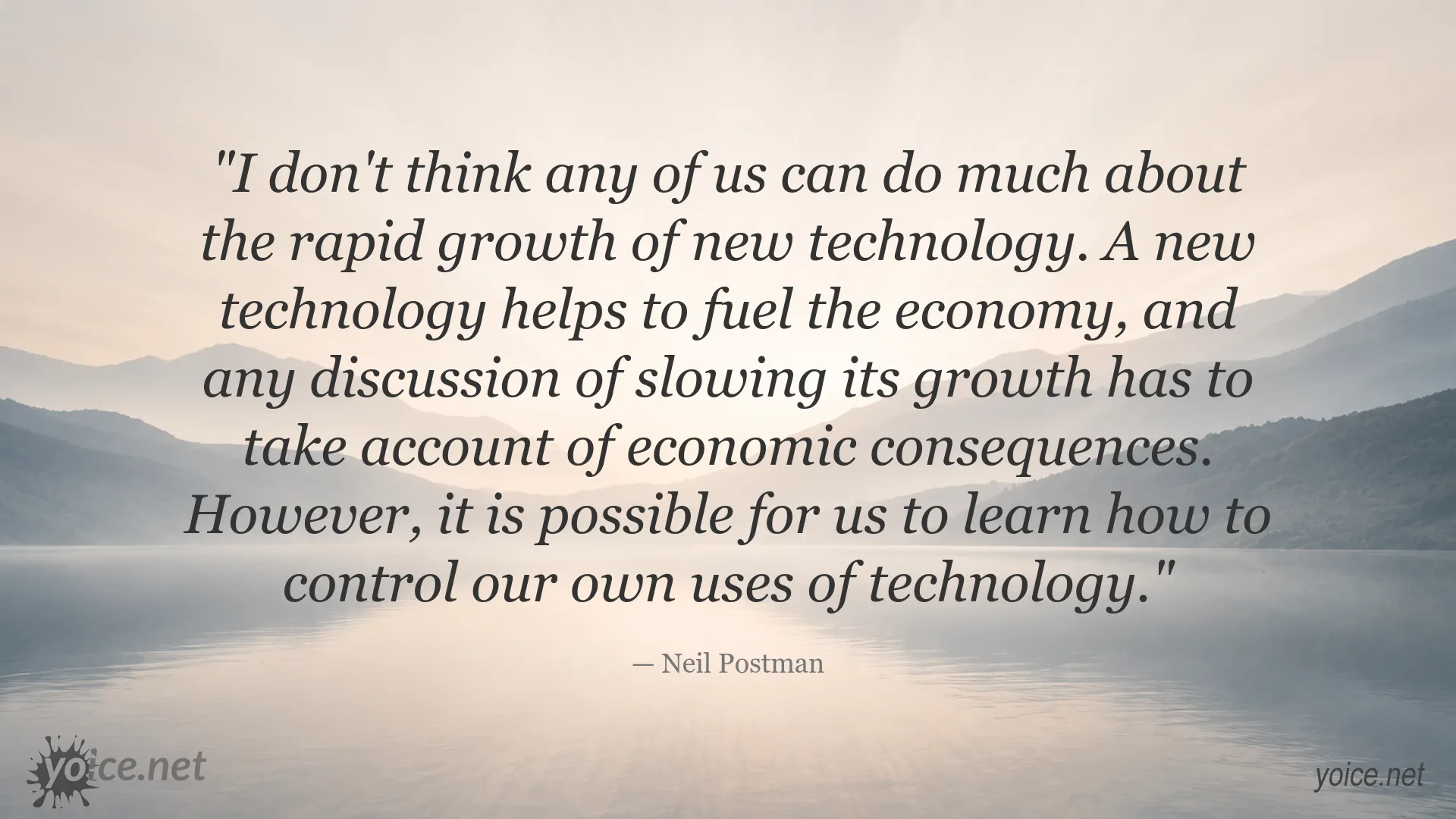
Link to: Virtue as True Nobility – Juvenal Link to: Virtue as True Nobility – Juvenal Virtue as True Nobility – JuvenalInspirational quote by Juvenal about virtue being the only true nobilityCopyright © yoice.net – Quote Artwork Link to: Technology and Control – Neil Postman Link to: Technology and Control – Neil Postman Neil Postman quote about learning to control our uses of technologyCopyright © yoice.net – Quote ArtworkTechnology and Control – Neil Postman
Scroll to top Scroll to top Scroll to top
Manage Consent
To provide the best experiences, we use technologies like cookies to store and/or access device information. Consenting to these technologies will allow us to process data such as browsing behavior or unique IDs on this site. Not consenting or withdrawing consent, may adversely affect certain features and functions.
Functional Always active
The technical storage or access is strictly necessary for the legitimate purpose of enabling the use of a specific service explicitly requested by the subscriber or user, or for the sole purpose of carrying out the transmission of a communication over an electronic communications network.
Preferences
The technical storage or access is necessary for the legitimate purpose of storing preferences that are not requested by the subscriber or user.
Statistics
The technical storage or access that is used exclusively for statistical purposes. The technical storage or access that is used exclusively for anonymous statistical purposes. Without a subpoena, voluntary compliance on the part of your Internet Service Provider, or additional records from a third party, information stored or retrieved for this purpose alone cannot usually be used to identify you.
Marketing
The technical storage or access is required to create user profiles to send advertising, or to track the user on a website or across several websites for similar marketing purposes.
  • Manage options
  • Manage services
  • Manage {vendor_count} vendors
  • Read more about these purposes
View preferences
  • {title}
  • {title}
  • {title}