• Link to Youtube Link to Youtube Link to Youtube
  • Link to Telegram Link to Telegram Link to Telegram
  • Link to X Link to X Link to X
yoice.net
  • Quotes | yoice.net
    • Authors
      • Albert Einstein
      • Aldous Huxley
      • Ayn Rand
      • Edward Bernays | Father of modern propaganda
      • Friedrich Nietzsche | Quotes Collection
      • George Orwell | Quotes Collection
      • Hannah Arendt | Quotes, philosophies and timeless wisdom
      • Henry Louis Mencken | Astute critic and satirist
      • Joost A.M. Meerloo
      • Julian Huxley
      • Noam Chomsky
      • Sergei Kapiza
      • Walter Lippmann
    • Tags
      • Anarchy | Wisdom and the Philosophy of Freedom
      • Education
      • COVID1984 Quotes | Revealing the Madness
      • Democracy | Some revealing quotes
      • Money creation | Quotes about the magic of money
      • Jesuit
      • Mass media
      • Truth
      • Science
  • Earth Curve Calculator
  • Saved Quotes & Inspirations
  • Menu Menu

Yuval Noah Harari on Truth, Power, and Society – Revealing Insights!

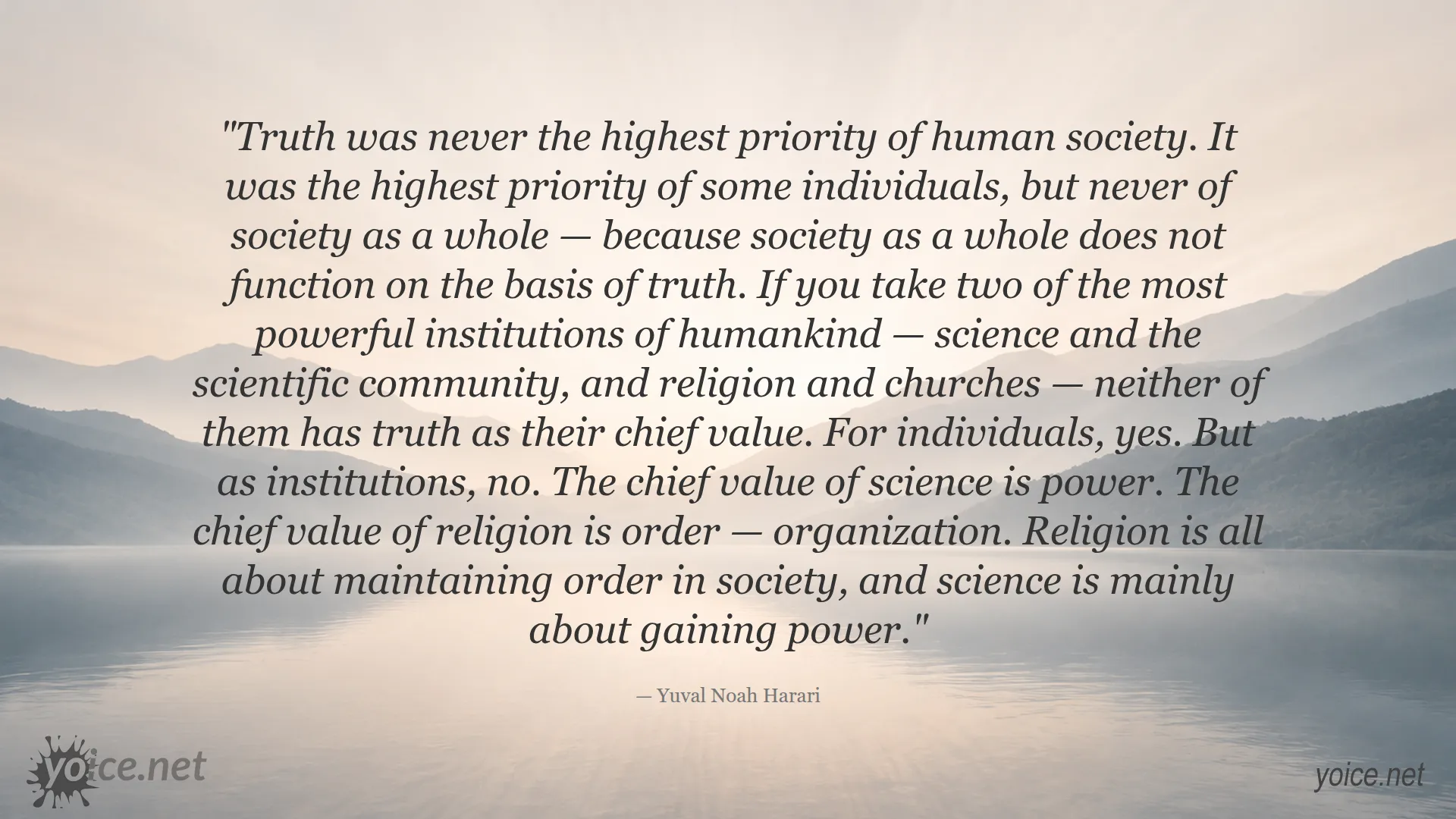
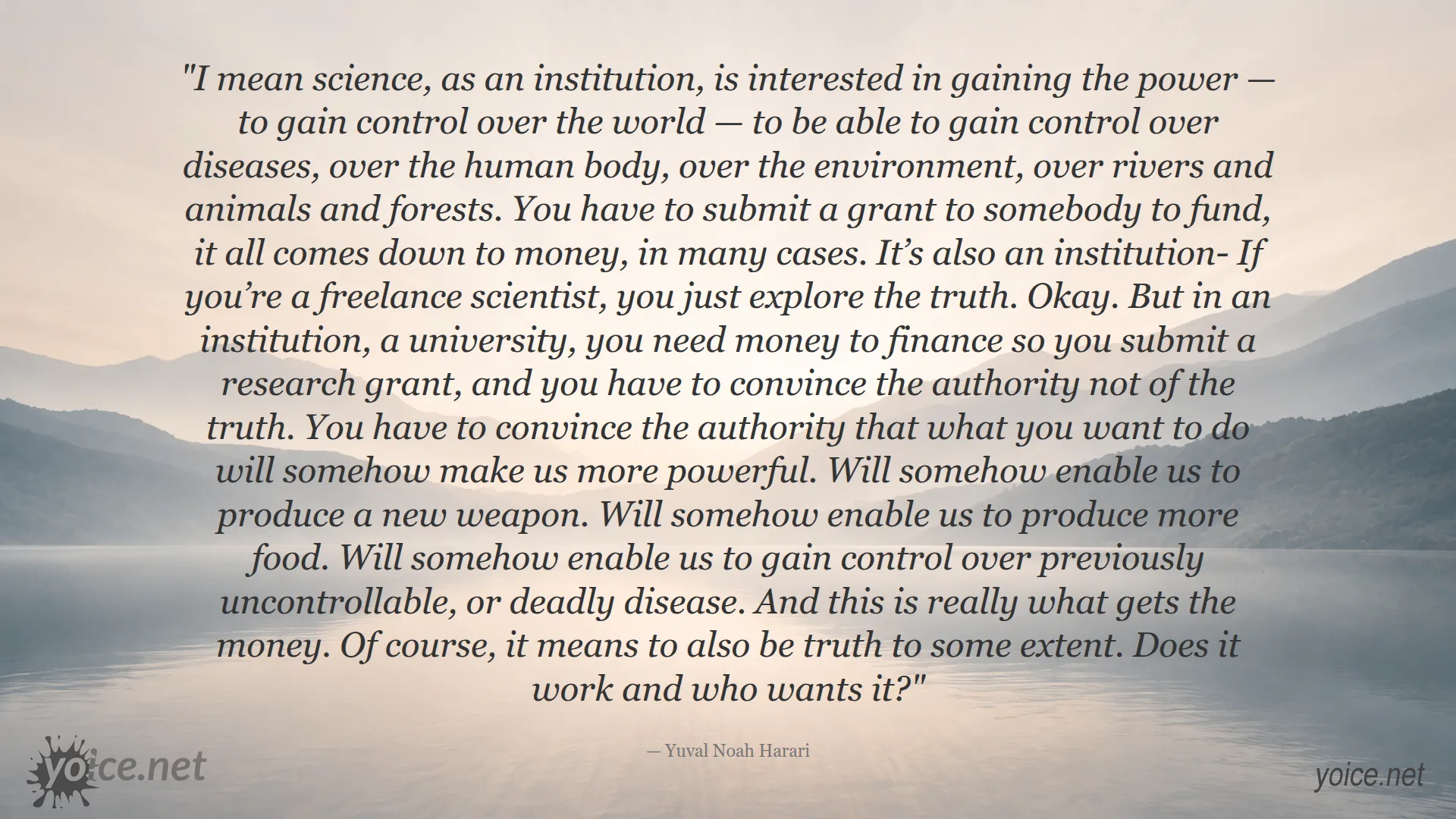
„Truth was never the highest priority of human society. It was the highest priority of some individuals, but never of society as a whole — because society as a whole does not function on the basis of truth. If you take two of the most powerful institutions of humankind — science and the scientific community, and religion and churches — neither of them has truth as their chief value. For individuals, yes. But as institutions, no. The chief value of science is power. The chief value of religion is order — organization. Religion is all about maintaining order in society, and science is mainly about gaining power.“

Yuval Noah HarariYuval Noah Harari reveals why truth was never a top priority in societies – science and religion primarily pursue power and order.
Previous Previous Previous Next Next Next

Yuval Noah Harari is an Israeli historian and bestselling author known for his works on history, technology, and the future of humanity.

Harari reminds us that societal institutions like science and religion do not primarily serve truth, but rather pursue power and order as their main goals.


Translation or original: 🇩🇪Click here

Quelle: Hier klicken

i
3.0 / 5
👥 Community:
Yuval Noah Harari|authority, education, fear industry, flat earth, philosophy, psychology, science, technocracy, truth
Share this entry
  • Facebook Facebook Share on Facebook
  • Whatsapp Whatsapp Share on WhatsApp
  • Paper-plane Paper-plane Share on Telegram
  • Mail Mail Share by Mail

Yuval Noah Harari (born 1976) is an Israeli historian and professor at the Hebrew University of Jerusalem. He gained international fame through his popular books such as 'Sapiens: A Brief History of Humankind' and 'Homo Deus', where he analyzes the development of humanity, society, and technology.
Asch on Majority Opinion and Authority – Joost A.M. Meerloo

29. April 2026
/
0 Comments
Read more

Fear of Freedom – Joost A.M. Meerloo

28. April 2026
/
0 Comments
Read more

The Urge to Save Humanity – Henry Louis Mencken

24. April 2026
/
0 Comments
Read more

Knowledge is found only by those who have questions – Hans-Georg Gadamer

21. April 2026
/
0 Comments
Read more

Erich Fromm on Human Roles and Personality

21. April 2026
/
0 Comments
Read more

Heraclitus of Ephesus Quotes: Great Results Require Great Ambition!

14. April 2026
/
0 Comments
Read more
0 replies

Leave a Reply

Want to join the discussion?
Feel free to contribute!

Leave a Reply Cancel reply

You must be logged in to post a comment.

Truth was never the highest priority of human society. It was the highest priority of some individuals, but never of society as a whole — because society as a whole does not function on the basis of truth. If you take two of the most powerful institutions of humankind — science and the scientific community, and religion and churches — neither of them has truth as their chief value. For individuals, yes. But as institutions, no.

The chief value of science is power. The chief value of religion is order — organization. Religion is all about maintaining order in society, and science is mainly about gaining power. They use truth to some extent, on the way to achieving power or order — but it’s not their ultimate aim.

Host Dan Ariely: Power? What do you mean by power?

Science, as an institution, is interested in gaining the power to control the world — to control diseases, the human body, the environment, rivers, animals, and forests. When you apply for a research grant, it often comes down to money. If you’re a freelance scientist, you can just explore the truth. Fine. But within an institution — a university — you need funding.

So you submit a grant proposal, and you don’t convince the authority of the truth. You have to convince them that what you’re doing will make us more powerful — that it will help us produce a new weapon, grow more food, or gain control over a previously uncontrollable epidemic. That’s what gets the money.

Of course, it also needs to be somewhat true — if it doesn’t work, nobody wants it. Medicine is about controlling disease. Engineering is about building dams to stop rivers from flowing.

Host Dan Ariely: The language of control can sound a bit negative — like a psychosis, or something unpleasant. Couldn’t we say that science wants to improve the human condition? That we want to understand and make things better — which sounds more positive than just control?

It’s not a contradiction — it’s a matter of framing. If you look at hundreds of years of scientific progress, not in all cases, but in many, the basic idea was: in order to improve the human condition, we need to control something.

It’s not like, “Let’s all do yoga and that will improve the human condition.” It’s more like, “How do we build a dam? How do we cut down a forest? How do we produce a new kind of antibiotic?” Things like that. Yes, there are exceptions, but looking at the big picture — 500 years of modern science — I think it was much more about gaining control than about anything else, when it comes to improving the human condition.

The first breakthrough scientific discipline that launched the scientific revolution, in my view, was geography. All these sailors and explorers leaving Europe in the 14th, 15th, and 16th centuries, exploring the world and mapping it — that was the first big scientific project: to map the world.

People often mention astronomy — Copernicus, Galileo — but that was a side issue. The real focus was geography and exploration. That’s where the big money went. And the reason was clear: the kings of Spain, Portugal, France, and the bankers of Genoa and Venice understood — correctly — that mapping the world was the first step toward conquering it.

This proved that science is a worthwhile investment. Astronomy — is the sun in the center, or the earth? — who cares? How do you make money from that? How do you conquer territories with that? But geography — the king of France saw that the king of Spain gave money to Columbus and Magellan, and now he has gold from Mexico. I want that too.

So the first successful project of modern science was the mapping of the world. And it was obvious to everyone: it wasn’t driven by curiosity — it was driven by the desire to control and to conquer.

We want to conquer.

QR Code
Aristoteles Yuval Noah Harari Bertolt Brecht Benjamin Franklin Confucius Helmut Schmidt Marcus Aurelius Vladimir Lenin Gary Lawrence Francione John Lennon Hannah Arendt Napoleon Bonaparte Hans-Georg Gadamer Ayn Rand Bertrand Russell Roland Baader Voltaire Winston Churchill Noam Chomsky Mark Twain Leonardo da Vinci Goethe Aldous Huxley Walter Lippmann H. L. Mencken Albert Einstein Edward Bernays George Orwell Joost A.M. Meerloo George Bernard Shaw Friedrich Nietzsche Thomas Alva Edison Henry Ford Leo Tolstoi Steve Jobs Thomas Sowell Mahatma Gandhi Albert Schweitzer Alicia Silverstone Carl Gustav Jung Thomas Jefferson Unbekannt John Adams William Shakespeare Abraham Lincoln Napoleon Hill Harvey Reginald Specter Ludwig von Mises Fred Hoyle Plato
©yoice.net • Realisierung: jan@pixel-park.net • Hosting - yoice.net Media • moyo-film.de | *As an Amazon Associate I earn from qualifying purchases.
  • Link to Youtube Link to Youtube Link to Youtube
  • Link to Telegram Link to Telegram Link to Telegram
  • Link to X Link to X Link to X
  • Contact
  • Cookie Policy (EU)
  • Privacy Policy
  • imprint
Link to: The Best Place to Find Things – Edward Bernays Link to: The Best Place to Find Things – Edward Bernays The Best Place to Find Things – Edward Bernays Link to: Sophocles Quotes on Success – The Truth About Hard Work and Achievement Link to: Sophocles Quotes on Success – The Truth About Hard Work and Achievement Sophocles Quotes on Success – The Truth About Hard Work and Achievement
Scroll to top Scroll to top Scroll to top
Manage Consent
To provide the best experiences, we use technologies like cookies to store and/or access device information. Consenting to these technologies will allow us to process data such as browsing behavior or unique IDs on this site. Not consenting or withdrawing consent, may adversely affect certain features and functions.
Functional Always active
The technical storage or access is strictly necessary for the legitimate purpose of enabling the use of a specific service explicitly requested by the subscriber or user, or for the sole purpose of carrying out the transmission of a communication over an electronic communications network.
Preferences
The technical storage or access is necessary for the legitimate purpose of storing preferences that are not requested by the subscriber or user.
Statistics
The technical storage or access that is used exclusively for statistical purposes. The technical storage or access that is used exclusively for anonymous statistical purposes. Without a subpoena, voluntary compliance on the part of your Internet Service Provider, or additional records from a third party, information stored or retrieved for this purpose alone cannot usually be used to identify you.
Marketing
The technical storage or access is required to create user profiles to send advertising, or to track the user on a website or across several websites for similar marketing purposes.
  • Manage options
  • Manage services
  • Manage {vendor_count} vendors
  • Read more about these purposes
View preferences
  • {title}
  • {title}
  • {title}