
„If you can’t prove it in an experiment, it’s called a belief.“
yoice.netyoice.net: Discover why without experimental proof everything remains belief – for more transparency and knowledge online.
This quote reminds us of the importance of critically questioning our beliefs and building on verifiable facts.
Translation or original: 🇩🇪Click here
Quelle: Hier klicken
i
3.0
/ 5
👥 Community:
Share this entry
 Copyright © yoice.net – Quote Artwork
"In Science, we always say that you make observations you have a theory you make more observations and it’s a very very tedious process… WRONG! Nobody that I know of in my field, uses the so-called Scientific Method. In our field, it’s by the seat of your pants, it’s leaps of logic, it’s GUESSWORK."
Dr. Michio Kaku
 Copyright © yoice.net – Quote Artwork
"For example, if I suspect that there might still be beer in the fridge and I check, then in principle I'm already doing a preliminary form of science. Big difference to theology. In theology, assumptions are not usually tested. So if I just say “there's beer in the fridge”, I'm a theologian. If I look, I'm a scientist. If I look, find nothing and still claim there's beer in it - then I'm an esoteric!"
Vince Ebert
 Copyright © yoice.net – Quote Artwork
"If you want to assert a truth, first make sure it’s not just an opinion that you desperately want to be true."
Neil deGrasse Tyson
 Copyright © yoice.net – Quote Artwork
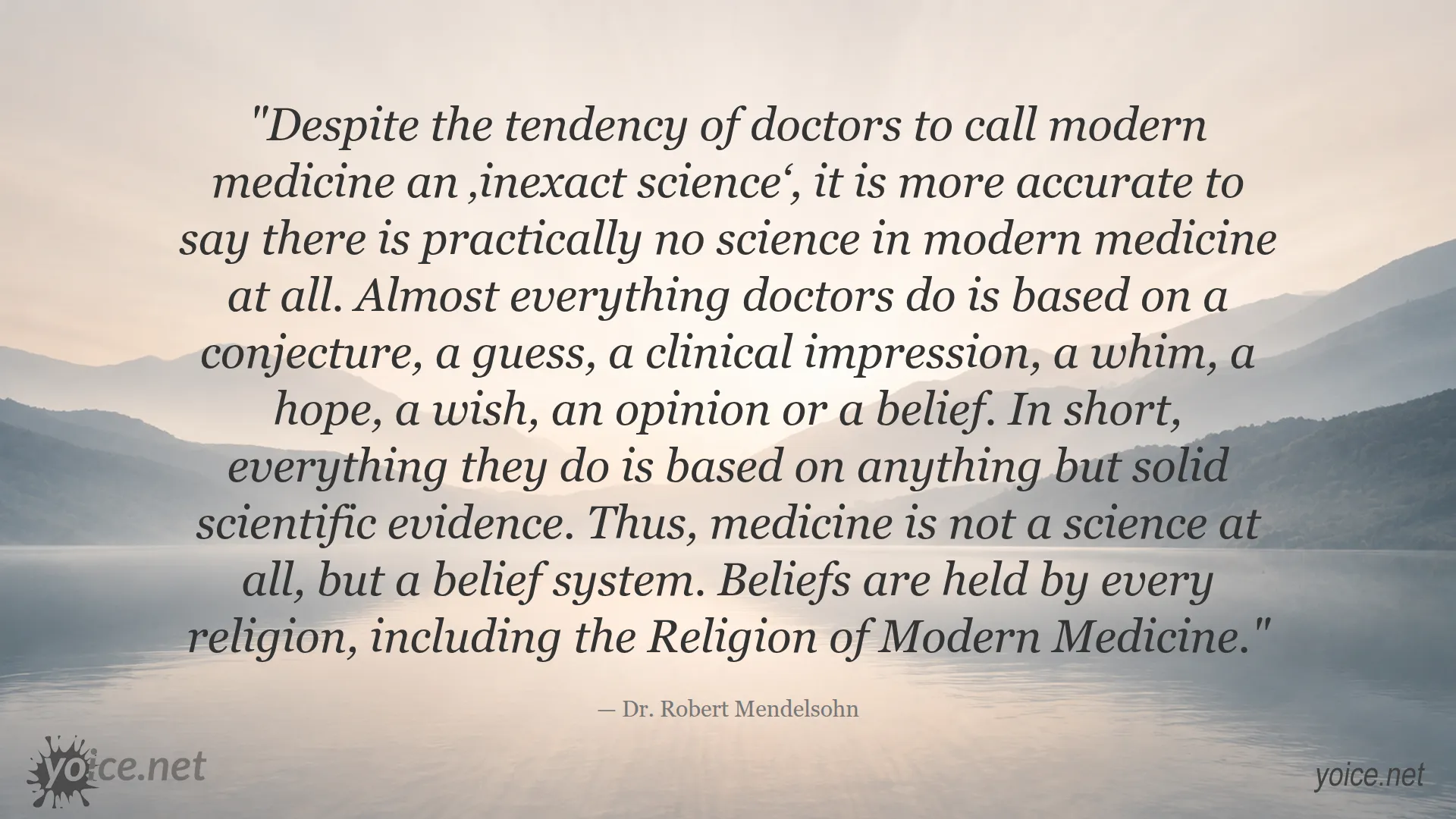
"Despite the tendency of doctors to call modern medicine an ‚inexact science‘, it is more accurate to say there is practically no science in modern medicine at all. Almost everything doctors do is based on a conjecture, a guess, a clinical impression, a whim, a hope, a wish, an opinion or a belief. In short, everything they do is based on anything but solid scientific evidence. Thus, medicine is not a science at all, but a belief system. Beliefs are held by every religion, including the Religion of Modern Medicine."
Dr. Robert Mendelsohn
 Copyright © yoice.net – Quote Artwork
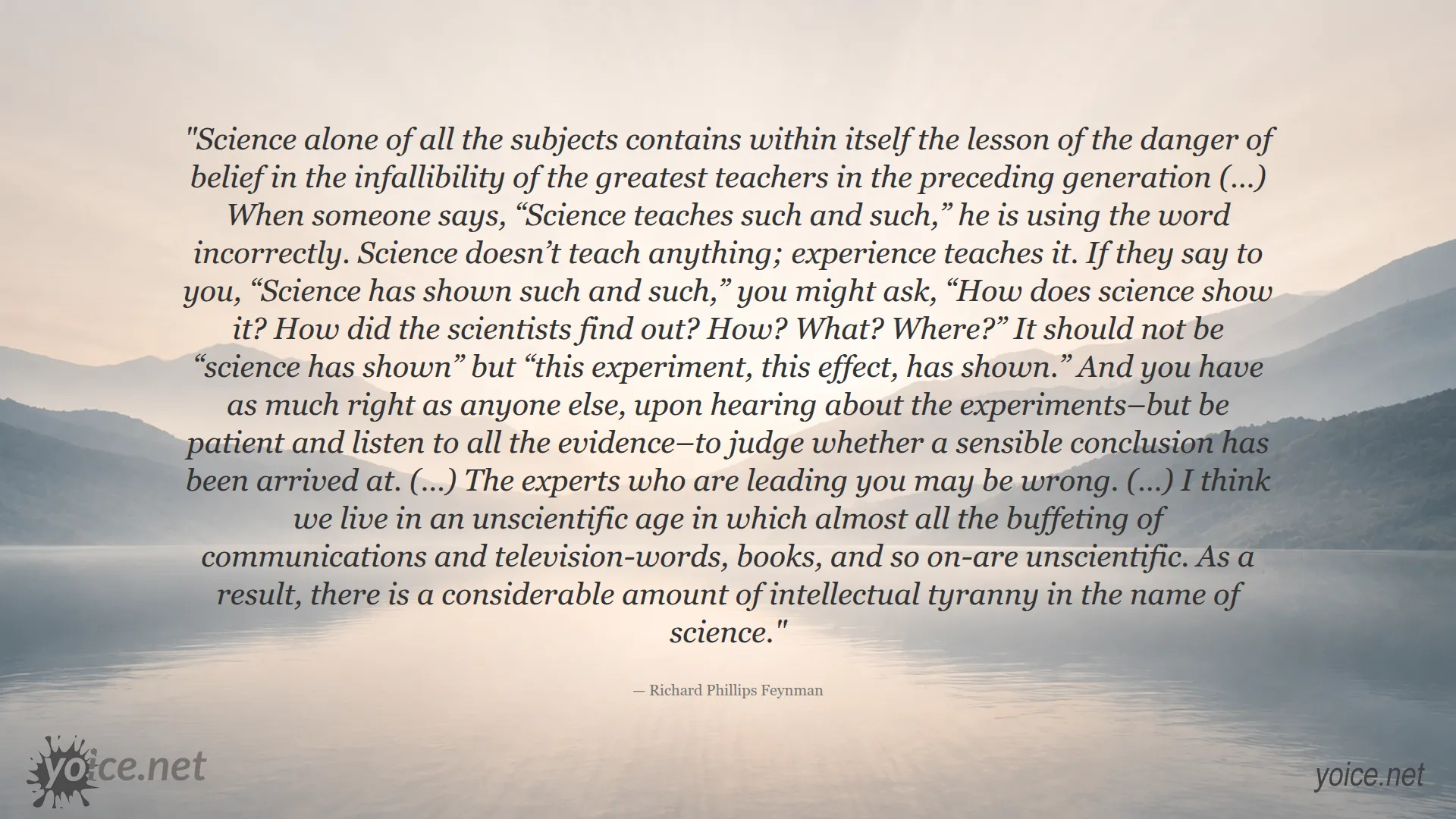
"Science alone of all the subjects contains within itself the lesson of the danger of belief in the infallibility of the greatest teachers in the preceding generation (…) When someone says, “Science teaches such and such,” he is using the word incorrectly. Science doesn’t teach anything; experience teaches it. If they say to you, “Science has shown such and such,” you might ask, “How does science show it? How did the scientists find out? How? What? Where?” It should not be “science has shown” but “this experiment, this effect, has shown.” And you have as much right as anyone else, upon hearing about the experiments–but be patient and listen to all the evidence–to judge whether a sensible conclusion has been arrived at. (…) The experts who are leading you may be wrong. (…) I think we live in an unscientific age in which almost all the buffeting of communications and television-words, books, and so on-are unscientific. As a result, there is a considerable amount of intellectual tyranny in the name of science."
Richard Phillips Feynman
 Copyright © yoice.net – Quote Artwork
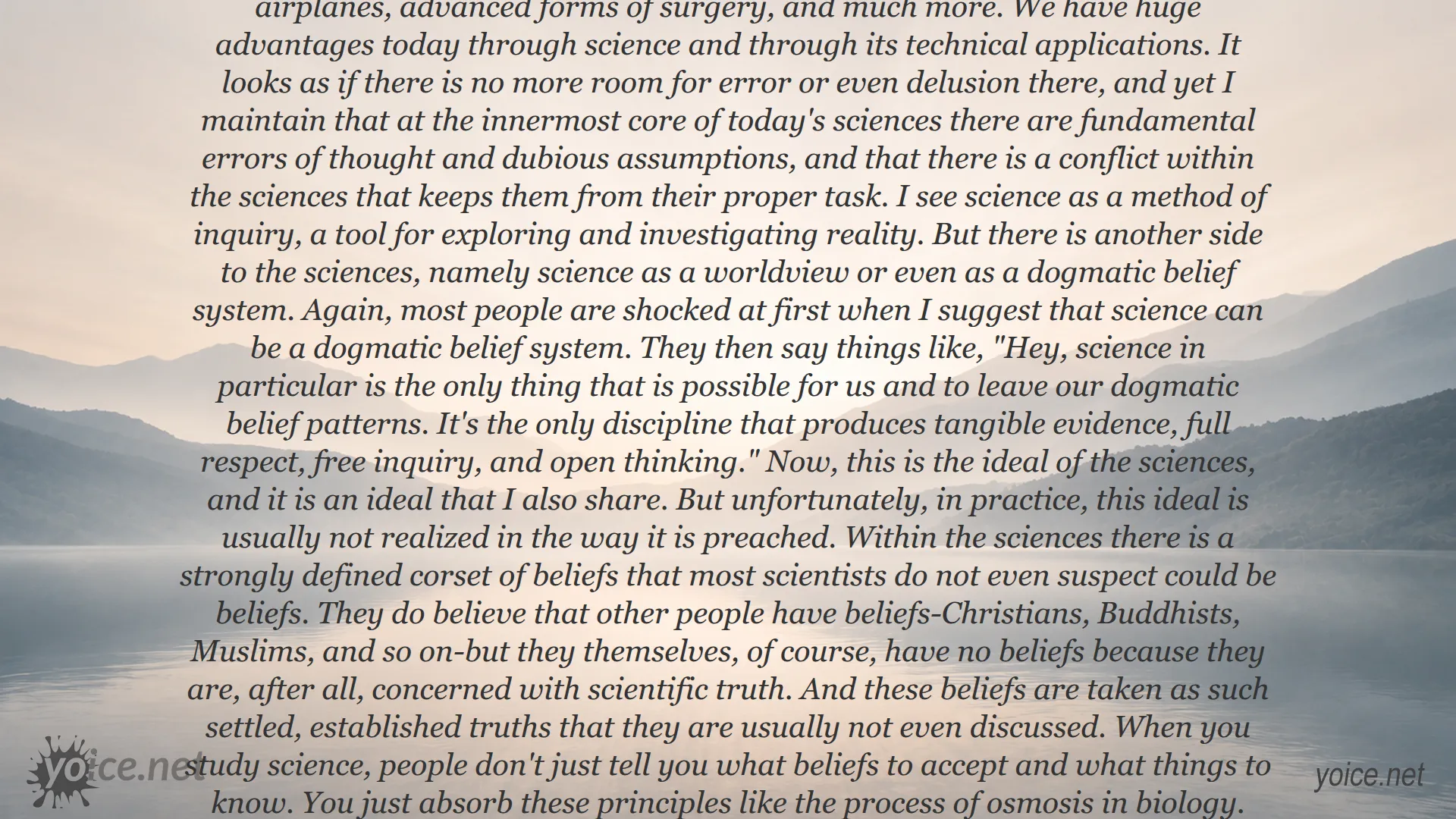
"Science delusion is the belief that science has already fundamentally understood the nature of our reality and only the details need to be completed. I believe this is a seriously flawed view. Most people's first reaction is one of disbelief and rejection when they first hear this statement. How could there actually be anything more successful than science? It has given us cell phones, computers, airplanes, advanced forms of surgery, and much more. We have huge advantages today through science and through its technical applications. It looks as if there is no more room for error or even delusion there, and yet I maintain that at the innermost core of today's sciences there are fundamental errors of thought and dubious assumptions, and that there is a conflict within the sciences that keeps them from their proper task. I see science as a method of inquiry, a tool for exploring and investigating reality. But there is another side to the sciences, namely science as a worldview or even as a dogmatic belief system. Again, most people are shocked at first when I suggest that science can be a dogmatic belief system. They then say things like, "Hey, science in particular is the only thing that is possible for us and to leave our dogmatic belief patterns. It's the only discipline that produces tangible evidence, full respect, free inquiry, and open thinking." Now, this is the ideal of the sciences, and it is an ideal that I also share. But unfortunately, in practice, this ideal is usually not realized in the way it is preached. Within the sciences there is a strongly defined corset of beliefs that most scientists do not even suspect could be beliefs. They do believe that other people have beliefs-Christians, Buddhists, Muslims, and so on-but they themselves, of course, have no beliefs because they are, after all, concerned with scientific truth. And these beliefs are taken as such settled, established truths that they are usually not even discussed. When you study science, people don't just tell you what beliefs to accept and what things to know. You just absorb these principles like the process of osmosis in biology. These are things that are treated with such a matter of course that you just assume they must be true. Most people outside the scientific world assume that they must be true because science is simply so successful and, as a result, enjoys an enormously high level of prestige today."
Rupert Sheldrake
 Copyright © yoice.net – Quote Artwork
 Copyright © yoice.net – Quote Artwork
Leave a Reply
Want to join the discussion?Feel free to contribute!