„In so far as a scientific statement speaks about reality, it must be falsifiable; and in so far as it is not falsifiable, it does not speak about reality.“
Karl PopperKarl Popper on falsifiability as a central criterion of scientific statements and their connection to reality.
Karl Popper was an Austrian-British philosopher and the founder of critical rationalism.
Karl Popper presents a central criterion of scientific statements: their principle of falsifiability.
Translation or original: 🇩🇪Click here
Quelle: Hier klicken
i
3.0
/ 5
👥 Community:
Share this entry
Copyright © yoice.net – Quote Artwork"As far as the laws of mathematics refer to reality, they are not certain; and as far as they are certain, they do not refer to reality."
Albert Einstein
Copyright © yoice.net – Quote Artwork"I like to distinguish between the scientific method, which is applied to all materialistic theories. The scientific method is one of observation or experimentation, repeatability, falsification, the repeatability by different techniques of different labs, or prediction and results. It's a scientific method. I say that if it's a non-physical theory, or the theory has any aspect of non-physicalism to it, it doesn't have to be all, any aspect invalidates, to some degree invalidates, the scientific method as I just described from being applicable. And I think there's a tendency in some theories that have some non-physical aspect to try to show their legitimacy by applying the scientific method... I think that's a false desire, because once you're non-physical you are invalidating, to one degree or another, the scientific method. Maybe not totally, but in some degree."
Robert Lawrence Kuhn
Copyright © yoice.net – Quote Artwork"Science alone of all the subjects contains within itself the lesson of the danger of belief in the infallibility of the greatest teachers in the preceding generation (…) When someone says, “Science teaches such and such,” he is using the word incorrectly. Science doesn’t teach anything; experience teaches it. If they say to you, “Science has shown such and such,” you might ask, “How does science show it? How did the scientists find out? How? What? Where?” It should not be “science has shown” but “this experiment, this effect, has shown.” And you have as much right as anyone else, upon hearing about the experiments–but be patient and listen to all the evidence–to judge whether a sensible conclusion has been arrived at. (…) The experts who are leading you may be wrong. (…) I think we live in an unscientific age in which almost all the buffeting of communications and television-words, books, and so on-are unscientific. As a result, there is a considerable amount of intellectual tyranny in the name of science."
Richard Phillips Feynman
Copyright © yoice.net – Quote Artwork"To be scientific, that is to know what one knows and what one does not know; unscientific is dogmatic knowledge. To be scientific is to know with reasons; to accept ready-made opinions is unscientific. Scientific is the knowledge with the consciousness of the respectively determined limits of the knowledge; unscientific is all total knowledge, as if one knew in the whole. Scientific is boundless criticism and self-criticism, the advancing questioning; unscientific is the concern that doubt could paralyze. Scientific is the methodical course, which step by step on the ground of experience penetrates to the decision; unscientific is the play of multiple opinions and possibilities and the murmuring."
Karl Jaspers
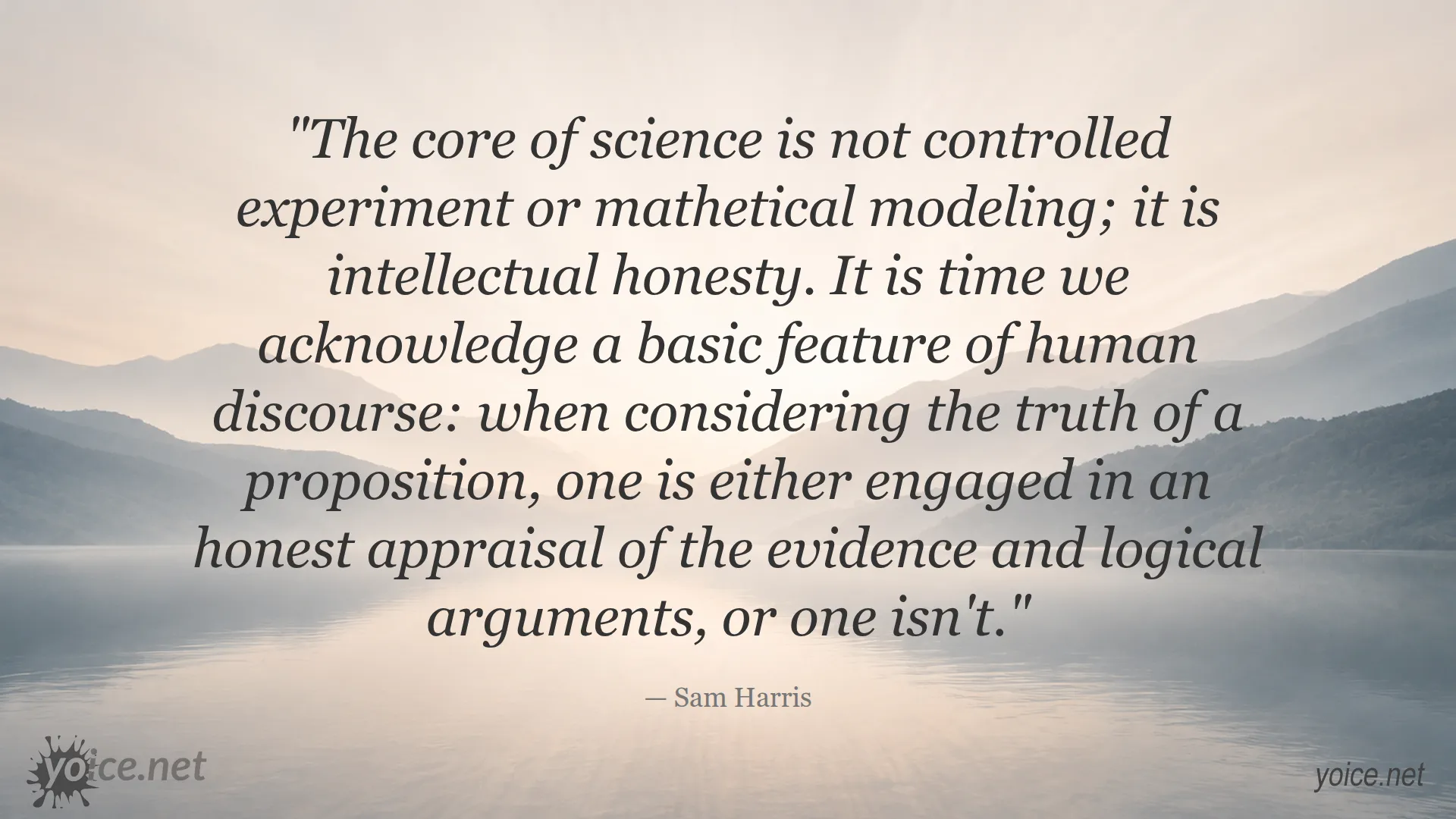
Copyright © yoice.net – Quote Artwork"The core of science is not controlled experiment or mathetical modeling; it is intellectual honesty. It is time we acknowledge a basic feature of human discourse: when considering the truth of a proposition, one is either engaged in an honest appraisal of the evidence and logical arguments, or one isn't."
Sam Harris
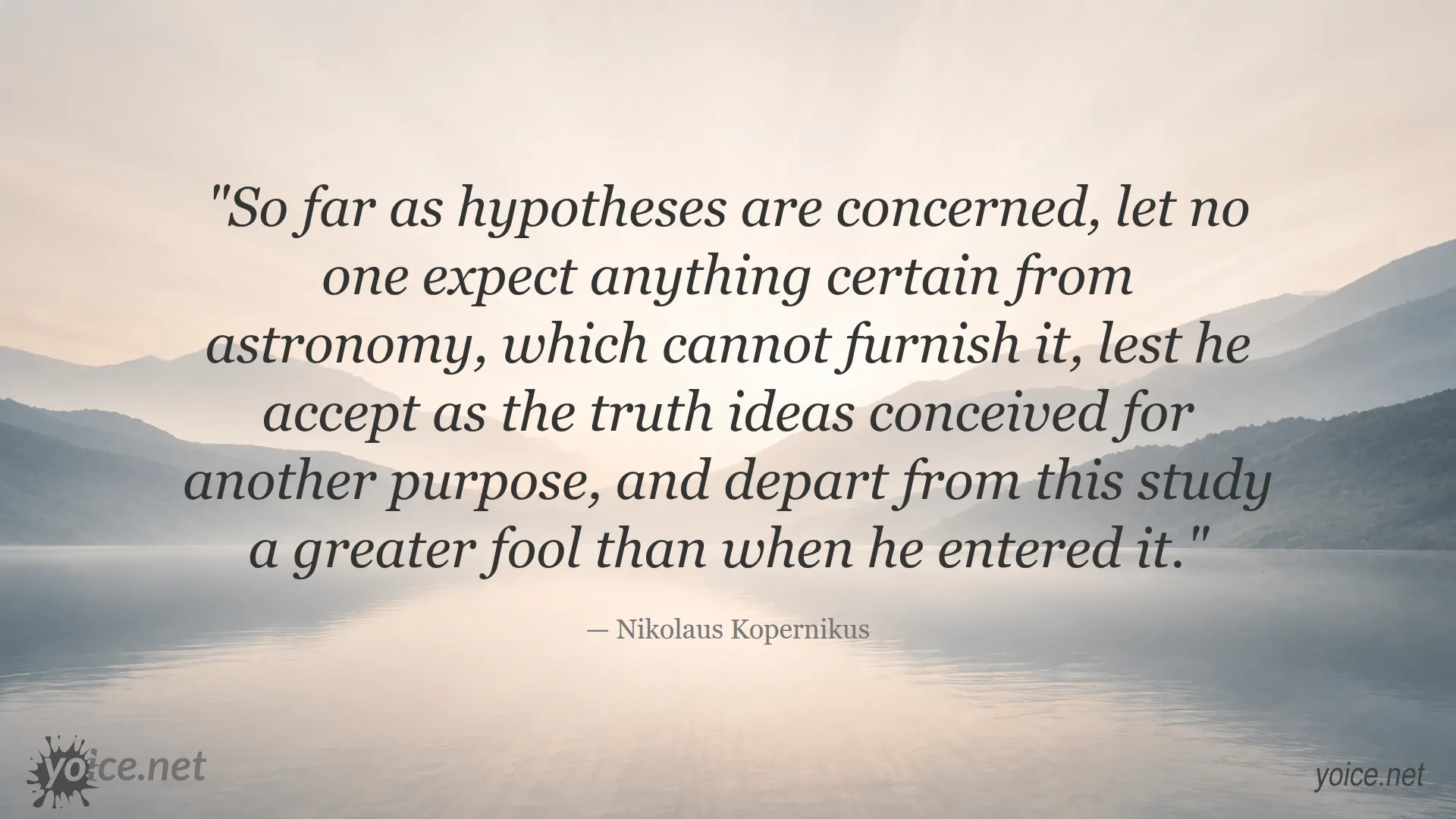
Copyright © yoice.net – Quote Artwork"So far as hypotheses are concerned, let no one expect anything certain from astronomy, which cannot furnish it, lest he accept as the truth ideas conceived for another purpose, and depart from this study a greater fool than when he entered it."
Nikolaus Kopernikus


Leave a Reply
Want to join the discussion?Feel free to contribute!