
„Whoever has the power in society determines what can be studied, determines what can be observed, determines what can be thought. Scientists fall in line with the dominant power structure. They have to because the power structure pays the bills.“
Danny MinotDanny Minot reveals how power dictates what science can research and think. A quote about control and society.
Danny Minot is a thinker and critic who examines power structures and their influence on science and society.
This quote powerfully illustrates how power sets the limits of knowledge and thought – a call for critical reflection on the control of science.
Translation or original: 🇩🇪Click here
Quelle: Hier klicken
i
3.0
/ 5
👥 Community:
Share this entry

 Copyright © yoice.net – Quote Artwork
"…Whoever has the power in society determines what can be studied, determines what can be observed, determines what can be thought. Scientists fall in line with the dominant power structure. They have to, because the power structure pays the bills. You don’t play ball with the power structure, you don’t get money for research, you don’t get an appointment, you don’t get published, in short you don’t count anymore. You’re out. You might as well be dead."
Michael Crichton
 Copyright © yoice.net – Quote Artwork
"I mean science, as an institution, is interested in gaining the power — to gain control over the world — to be able to gain control over diseases, over the human body, over the environment, over rivers and animals and forests. You have to submit a grant to somebody to fund, it all comes down to money, in many cases. It’s also an institution- If you’re a freelance scientist, you just explore the truth. Okay. But in an institution, a university, you need money to finance so you submit a research grant, and you have to convince the authority not of the truth. You have to convince the authority that what you want to do will somehow make us more powerful. Will somehow enable us to produce a new weapon. Will somehow enable us to produce more food. Will somehow enable us to gain control over previously uncontrollable, or deadly disease. And this is really what gets the money. Of course, it means to also be truth to some extent. Does it work and who wants it?"
Yuval Noah Harari
 Copyright © yoice.net – Quote Artwork
"The sciences of today are business enterprises run on business principles. Research in large institutes is not guided by Truth and Reason but by the most rewarding fashion, and the great minds of today increasingly turn to where the money is - which means military matters."
Paul Feyerabend
 Copyright © yoice.net – Quote Artwork
"All things are subject to interpretation whichever interpretation prevails at a given time is a function of power and not truth."
Friedrich Nietzsche
 Copyright © yoice.net – Quote Artwork
"No one can be truly powerful unless he has access to the command of major institutions, for it is over these institutional means of power that the truly powerful are, in the first instance, truly powerful . . ."
Charles Wright Mills
 Copyright © yoice.net – Quote Artwork
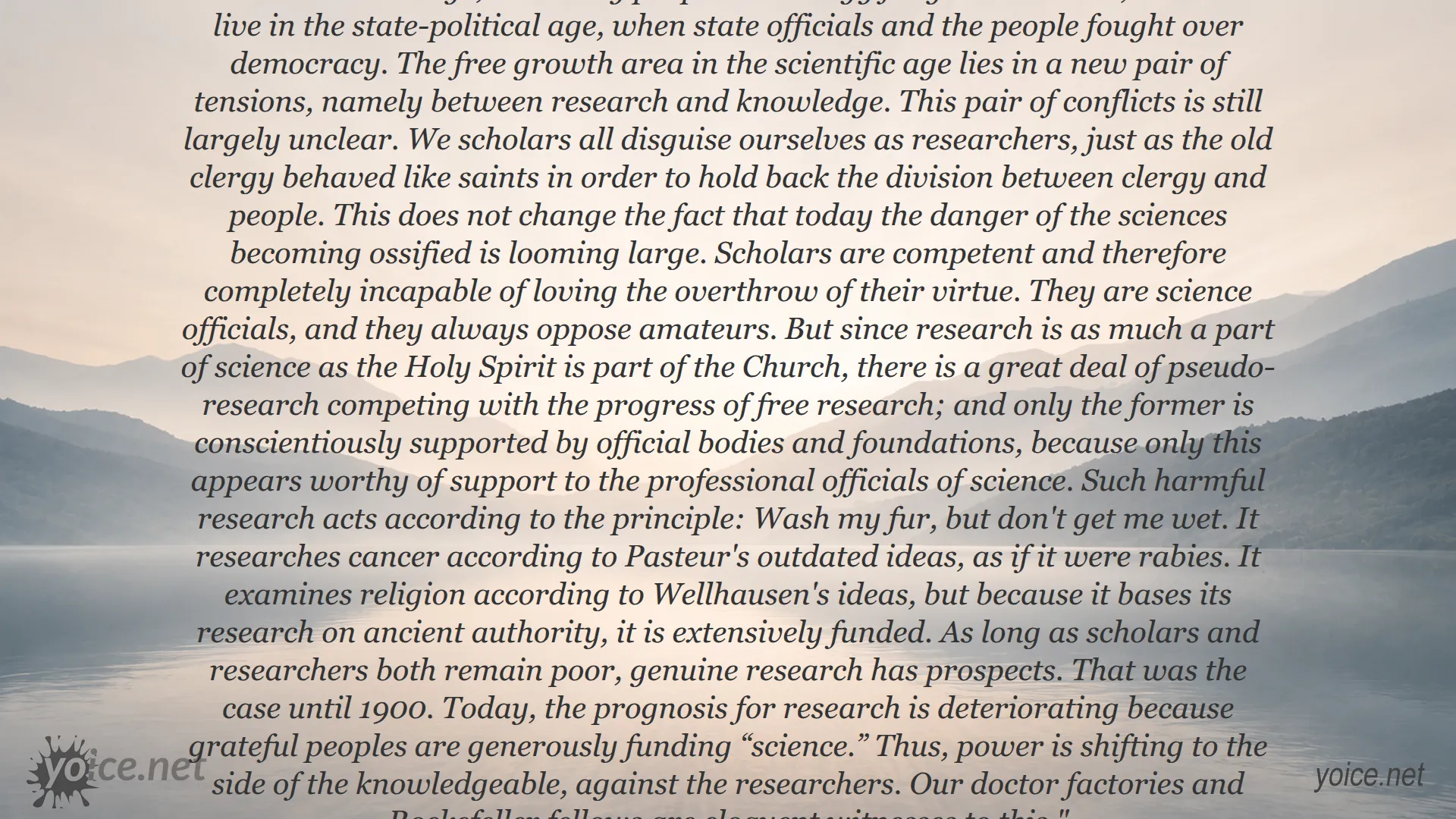
"Perhaps the following current example can best illustrate this point. We do not live in the clerical age, where lay people and clergy fought each other; nor do we live in the state-political age, when state officials and the people fought over democracy. The free growth area in the scientific age lies in a new pair of tensions, namely between research and knowledge. This pair of conflicts is still largely unclear.
We scholars all disguise ourselves as researchers, just as the old clergy behaved like saints in order to hold back the division between clergy and people. This does not change the fact that today the danger of the sciences becoming ossified is looming large.
Scholars are competent and therefore completely incapable of loving the overthrow of their virtue. They are science officials, and they always oppose amateurs. But since research is as much a part of science as the Holy Spirit is part of the Church, there is a great deal of pseudo-research competing with the progress of free research; and only the former is conscientiously supported by official bodies and foundations, because only this appears worthy of support to the professional officials of science.
Such harmful research acts according to the principle: Wash my fur, but don't get me wet.
It researches cancer according to Pasteur's outdated ideas, as if it were rabies.
It examines religion according to Wellhausen's ideas, but because it bases its research on ancient authority, it is extensively funded.
As long as scholars and researchers both remain poor, genuine research has prospects. That was the case until 1900. Today, the prognosis for research is deteriorating because grateful peoples are generously funding “science.” Thus, power is shifting to the side of the knowledgeable, against the researchers.
Our doctor factories and Rockefeller fellows are eloquent witnesses to this."
Eugen Rosenstock
 Copyright © yoice.net – Quote Artwork
 Copyright © yoice.net – Quote Artwork
Leave a Reply
Want to join the discussion?Feel free to contribute!