„Anxiety and unease, once tied to the oppression and abuse of the aristocracy and clergy, began to drift ineffably around in the human soul. Frustration and aggression, once held in check by fear of hell and the last judgment, proved increasingly easy to mobilize. The prospect of an afterlife dwindled and was readily replaced by belief in an artificially created, mechanistic-scientific paradise“
Mattias DesmetMattias Desmet describes the shift in fear and belief and their impact on the human soul in a historical context.
Mattias Desmet is a Professor of Clinical Psychology at the University of Ghent.
Insight into the change of human fears and beliefs over time.
Translation or original: 🇩🇪Click here
Quelle: Hier klicken
i
3.0
/ 5
👥 Community:
Share this entry
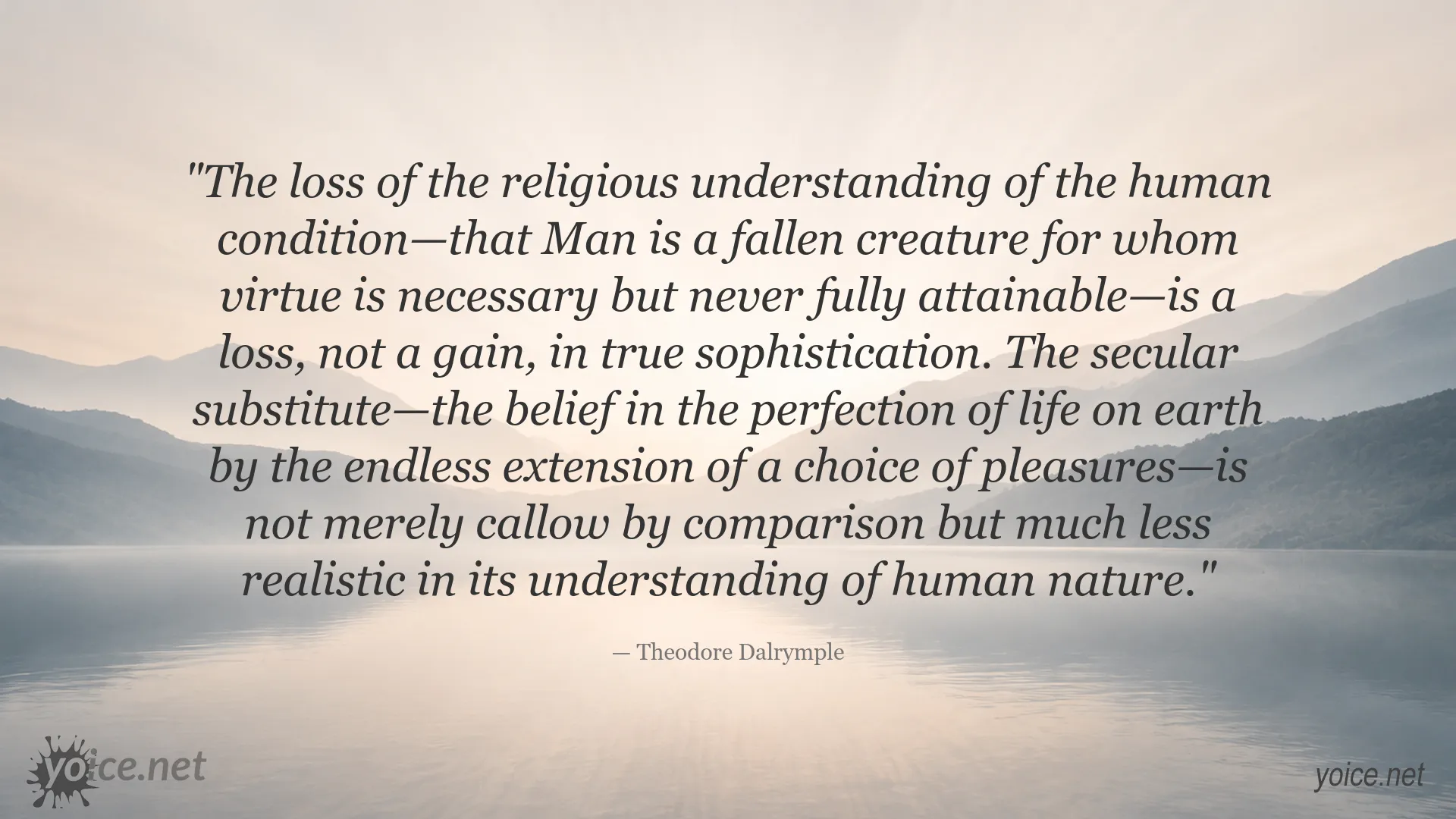
Copyright © yoice.net – Quote Artwork"The loss of the religious understanding of the human condition—that Man is a fallen creature for whom virtue is necessary but never fully attainable—is a loss, not a gain, in true sophistication. The secular substitute—the belief in the perfection of life on earth by the endless extension of a choice of pleasures—is not merely callow by comparison but much less realistic in its understanding of human nature."
Theodore Dalrymple
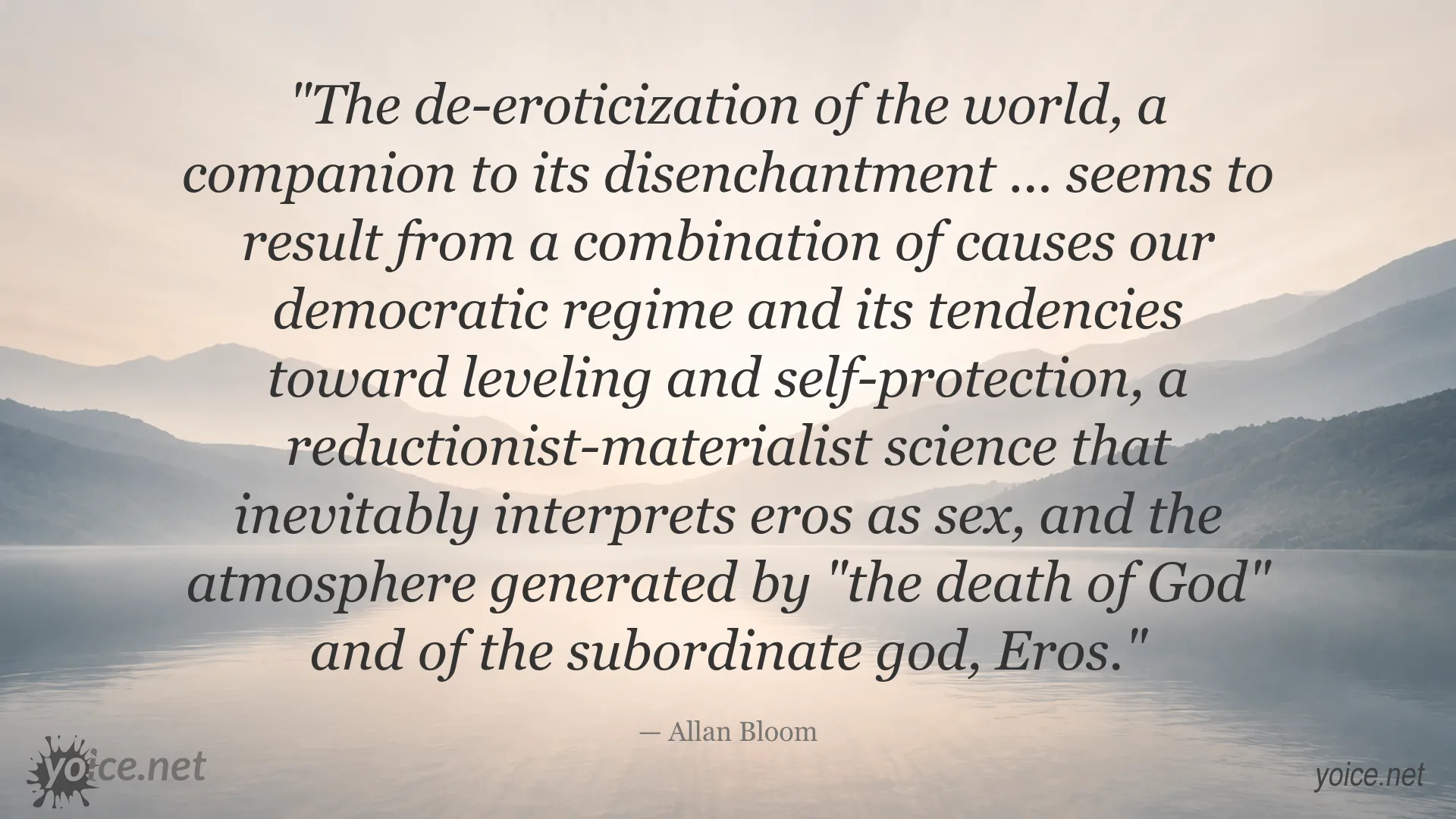
Copyright © yoice.net – Quote Artwork"The de-eroticization of the world, a companion to its disenchantment ... seems to result from a combination of causes our democratic regime and its tendencies toward leveling and self-protection, a reductionist-materialist science that inevitably interprets eros as sex, and the atmosphere generated by "the death of God" and of the subordinate god, Eros."
Allan Bloom
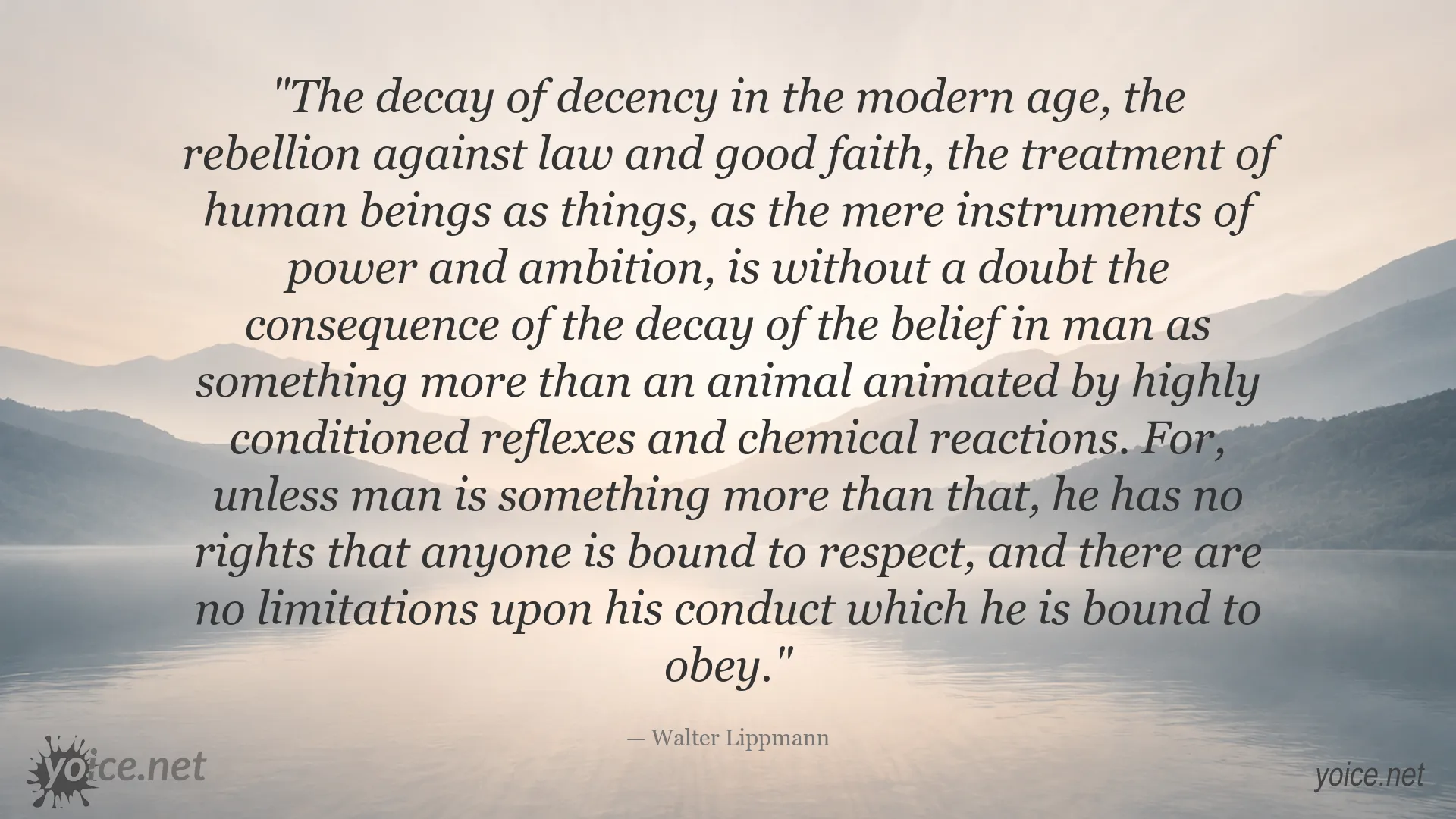
Copyright © yoice.net – Quote Artwork"The decay of decency in the modern age, the rebellion against law and good faith, the treatment of human beings as things, as the mere instruments of power and ambition, is without a doubt the consequence of the decay of the belief in man as something more than an animal animated by highly conditioned reflexes and chemical reactions. For, unless man is something more than that, he has no rights that anyone is bound to respect, and there are no limitations upon his conduct which he is bound to obey."
Walter Lippmann
Copyright © yoice.net – Quote Artwork"This process yields a psychological gain. Firstly, the anxiety that previously roamed through society as a tenebrous fog is now linked to a specific cause and can be mentally controlled via the strategy put forward in the story. Secondly, through a common struggle with “the enemy,” the disintegrating society regains its coherence, energy, and rudimentary meaning. For this reason, the fight against the object of anxiety then becomes a mission, laden with pathos and group heroism (for example, the Belgian government’s “team of 11 million” going to war against the coronavirus). Thirdly, in this fight all latent brewing frustration and aggression is taken out, especially on the group that refuses to go along with the story and the mass formation. This brings an enormous release and satisfaction to the masses, which they will not let go of easily. Through this process..."
Mattias Desmet
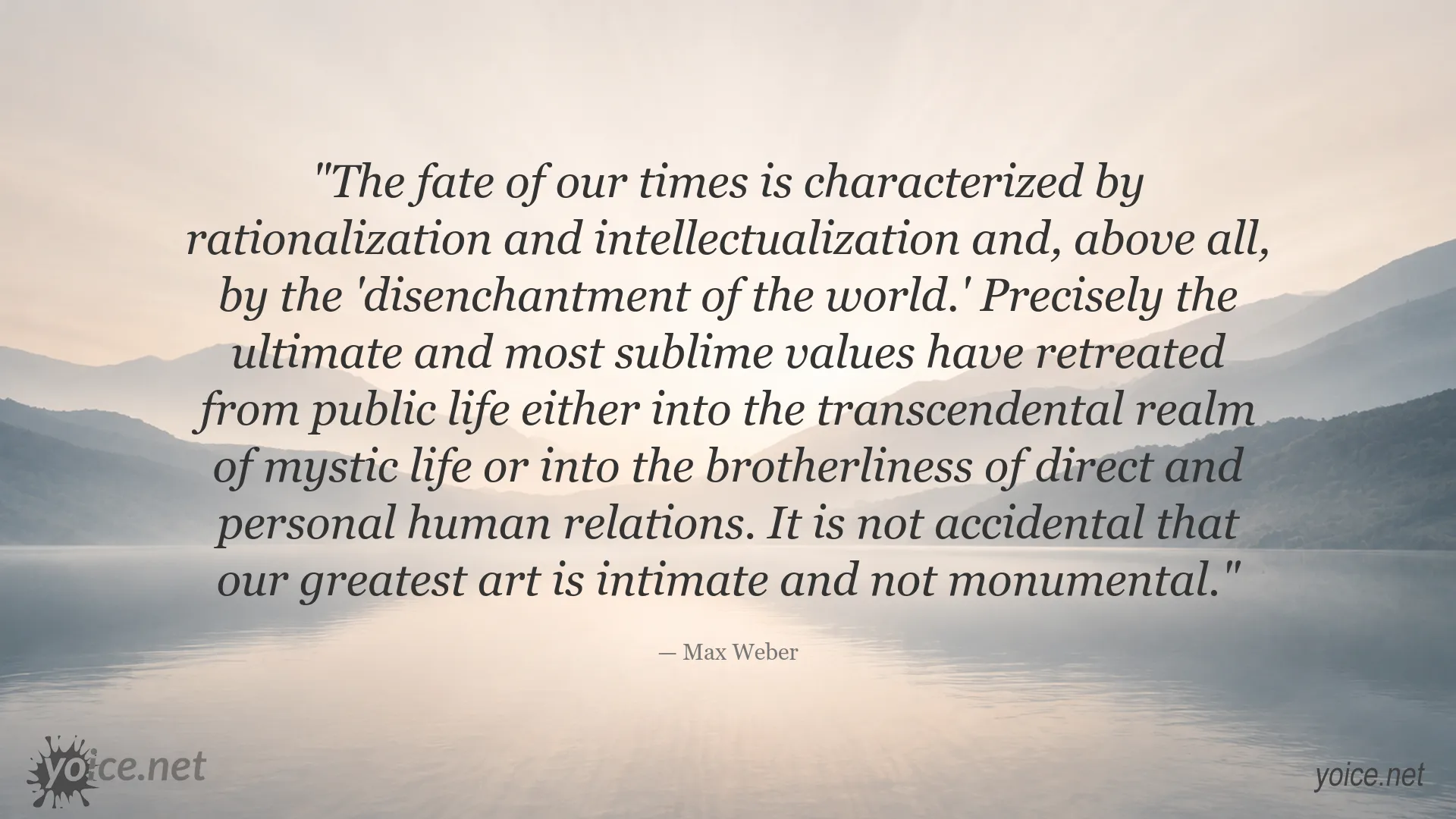
Copyright © yoice.net – Quote Artwork"The fate of our times is characterized by rationalization and intellectualization and, above all, by the 'disenchantment of the world.' Precisely the ultimate and most sublime values have retreated from public life either into the transcendental realm of mystic life or into the brotherliness of direct and personal human relations. It is not accidental that our greatest art is intimate and not monumental."
Max Weber
Copyright © yoice.net – Quote Artwork"How could the human mind progress, while tormented with frightful phantoms, and guided by men, interested in perpetuating its ignorance and fears? Man has been forced to vegetate in his primitive stupidity: he has been taught stories about invisible powers upon whom his happiness was supposed to depend. Occupied solely by his fears, and by unintelligible reveries, he has always been at the mercy of priests, who have reserved to themselves the right of thinking for him, and of directing his actions."
Paul-Henri Thiry d’Holbach


Leave a Reply
Want to join the discussion?Feel free to contribute!